
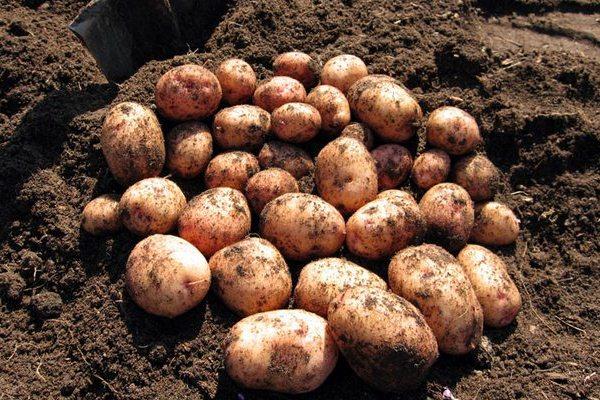
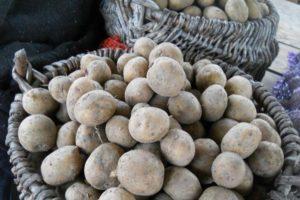
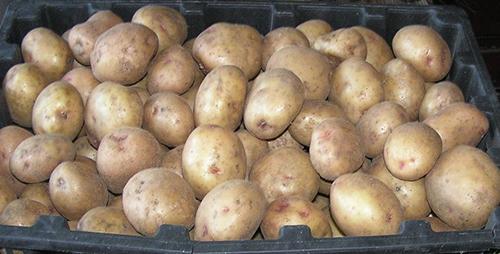
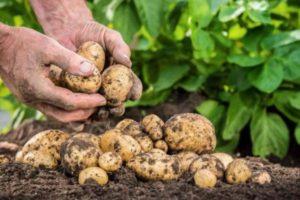
The Aurora potato is a mid-season variety, harvested 80-90 days after planting. Approximately 15-20 tubers are harvested per plant, making it a high-yielding variety. The fruits are large, weighing 90-150 grams each. They have a high starch content, and each fruit is covered in a brownish-pink skin with several shallow eyes. The flesh inside is creamy.
Description and characteristics
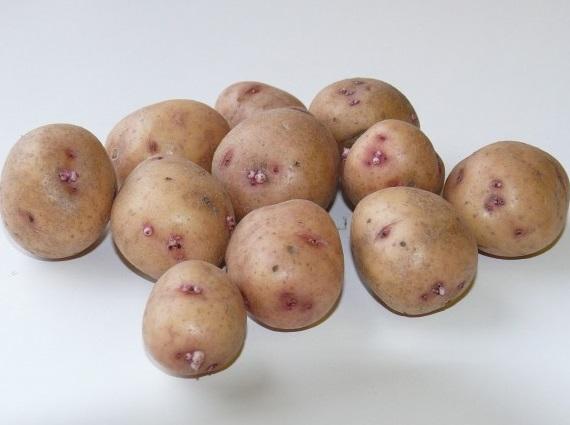
The potato produces light cream-colored, oval or round fruits. The skin is thick, with pink halos forming around the eyes. It has a high starch content, 15-20%. It softens when cooked. Each tuber averages 150 grams. The bushes are tall, with bright green leaves and wavy edges. It produces reddish-purple flowers.
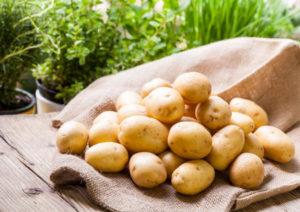
Aurora is a mid-season variety, harvested 80-90 days after planting. A single plant produces 15 to 20 tubers. The total yield is 250-400 kg of potatoes per hectare.
Positive and negative qualities
The Aurora variety has its positive and negative aspects. The positive aspects include:
- even, almost identical fruits;
- high yield;
- early maturity allows for 2 potato harvests in southern regions;
- good preservation of tubers until the next season;
- drought resistance;
- easy to care for;
- good taste.
The Aurora potato has several minor drawbacks:
- tall tops;
- susceptibility to diseases.
Growing Aurora potatoes
For planting, select the firmest fruits, free from damage, cracks, and rot, for Aurora. Two weeks before planting, place the fruit indoors with good lighting and a temperature of 15°C.
After sprouts appear on the tubers and the skin turns green, the potatoes are planted.
Soil preparation
The soil for growing potatoes is prepared in the fall. The selected area is dug over, removing all weeds and stones. Manure is added. The soil is left until spring. In the spring, 3-4 days before planting, the area is dug over again.
Important! Choose a planting site after growing legumes, cabbage, and corn. Potatoes should not be planted for three years after potatoes.
Planting technology
Planting takes place in mid- to late May, when the soil warms up to 10°C. The planting time depends on the growing region. In colder climates, this period begins in early June. In the prepared bed, make holes 25-30 centimeters apart. Each tuber is planted 10 centimeters into the soil. In colder climates, the depth should be 15 centimeters, and in hotter climates, 6-8 centimeters. The planting material is buried, and the bed surface is leveled with a rake.
In wet soils prone to frequent flooding, planting is done in a ridge. The tubers are planted at the edge of the bed. This allows excess water to drain away, preventing future crops from rotting.
Tips for caring for potatoes
To obtain a good harvest, it is necessary to monitor the watering of the beds, carry out hilling, and fertilizing.
Hilling
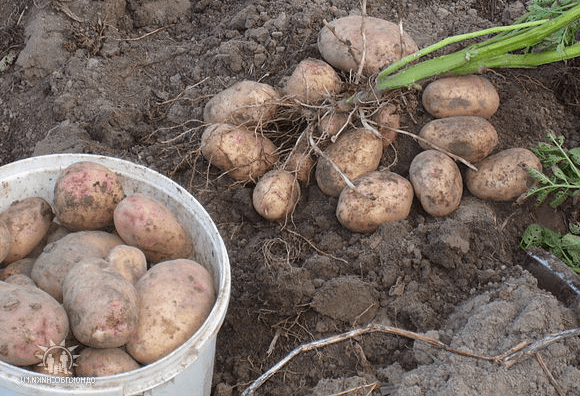
The first hilling is done when the bush reaches a height of 20 cm. The second is done 14 days later, and the third is done 21 days later. Hilling is done to a height of 17-20 cm from the base of the bush.
Hilling promotes improved fruit set and prevents excess moisture.
Watering
After the first potato sprouts appear, water each plant with 3 liters of water. A second watering is done during flowering. After flowering has ceased, check root formation and water again. Once strong roots have formed, stop watering.
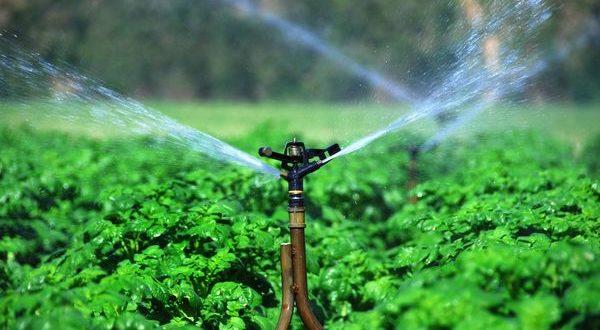 Important! Potatoes don't like high moisture levels. This should be taken into account when planting. If the soil is heavy and wet, drainage is recommended.
Fertilization
The best fertilizer for potatoes is manure or chicken manure. They are applied before planting, during soil preparation. A second application is made during bud formation, and a third during flowering. Mineral fertilizers containing nitrogen are also used. Apply any fertilizer strictly according to the instructions. Excessive amounts will cause plant death. The following are considered the best mineral fertilizers:
- saltpeter;
- nitroammophoska;
- urea.

Diseases and pests of the variety
The Aurora potato is resistant to golden nematode and potato cancer. However, it can still be affected by a number of diseases. These include:
- late blight;
- gray mold;
- brown rot;
- blackleg;
- necrosis;
- blackleg;
- scab;
- Alternaria;
- downy mildew.
To combat all these infections, regular treatments with copper sulfate are necessary. At the first sign of disease, all damaged areas of the stems are removed and treated.
The most common insect pests of potatoes are black aphids and the Colorado potato beetle. These insects can only be controlled by insecticide treatment. The beetles can also be manually picked from the leaves and destroyed. This method is time-consuming.
Cleaning and storage
Harvesting takes place in late summer or early fall. By this time, the plant's tops have dried out and are easily separated from the roots. Digging is done in dry weather. The potatoes are allowed to dry and then stored in cloth bags. At this time, a portion of the firm, healthy potatoes is selected for future plantings.
This variety has excellent shelf life. The harvest retains its appearance well until early spring. Store in a cool, dark place. The room temperature should be 2-5°C.
Reviews from summer residents
Vadim, 32 years old, Perm:
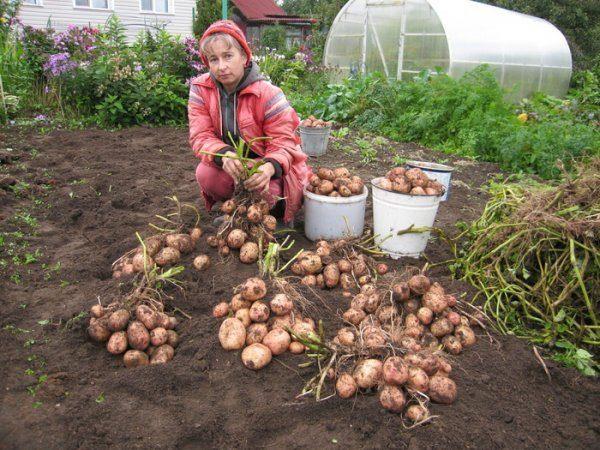
We bought trial ones this year potato seeds Aurora. This variety delighted us with the yield we got. We dug up 16-20 potatoes from each bush. All of them were uniform, with almost no eyes. We used them in various dishes; they tasted delicious. The flesh was light and creamy. It's an easy-to-care-for variety.
Alexandra, 46 years old, St. Petersburg:
We've been planting Aurora potatoes for four years now. They're an excellent variety with a high yield. We harvest about two bags of potatoes from a single bed. They store well; we have our own cellar, and we've never had any rot. By spring, the tubers, set aside for seed, remain straight. Caring for Aurora is easy: I hill them, weed, and loosen the soil. At the beginning of the season, I fertilize them with manure.
Take a look Also
Angelina, 45 years old, Kerch:
I've been familiar with the Aurora variety for a long time. We've been planting this particular variety for six years now. We like how easy it is to care for and store. We have a large family and plant a lot of potatoes. The high yield allows us to plant fewer plants. We get 17-20 tubers from one plant. If you water the plants well, they produce more. Since the potato stems are tall, I always hill them to encourage more fruit.
Related posts:
 Why potatoes aren't growing well in the garden, and what to do to ensure a bountiful harvest
 Advantages of the Aurora tomato and cultivation techniques for the hybrid
 Description of the best potato varieties of domestic and foreign selection
 Description and treatment of potato diseases, methods of control using folk and chemical means
 Description and characteristics of the Sante potato variety, planting rules and care
 Description and characteristics of the Gala potato variety, planting and care instructions
 Description and treatment of potato pests, control measures
 Characteristics and description of the Sineglazka potato variety, planting and care