
- The origin of the Vector variety
- Description and characteristics of the Vector potato
- Bush
- The yield of the Vector potato and the nutritional value of the tuber
- Advantages and Disadvantages
- Step-by-step instructions for growing potatoes
- What size potato tubers should be for planting?
- Selecting and preparing a planting site
- Timing and technology of planting potatoes
- Nuances of plant care
- Watering and fertilizing the Vector variety
- Loosening and mulching the soil
- Hilling potato beds
- What diseases and bugs are dangerous for Vector potatoes?
- How to properly harvest and store crops
- Vegetable growers' reviews of the Vector variety
The Vector potato variety is a Belarusian "discovery" widely cultivated in the CIS countries. It is grown for personal consumption and commercial sale. The fruit has excellent flavor and is highly transportable, allowing for easy long-distance shipping. Before planting, it's worth familiarizing yourself with all the nuances of this variety.
The origin of the Vector variety
The Vector potato variety was developed through experimental crossbreeding of the common Zarevo potato with the 1977-78 hybrid variety. The patent belongs to the Alexander Georgievich Lorkh All-Russian Research Institute of Potato Farming. The subspecies has been registered in the State Register since 2014.
Description and characteristics of the Vector potato
The Belarusian Vector potato is renowned for its good disease resistance and ability to thrive in almost any region, even in the North. It's a versatile table variety with excellent flavor. This is a mid-late variety. Tubers form 85-110 days after planting..
Bush
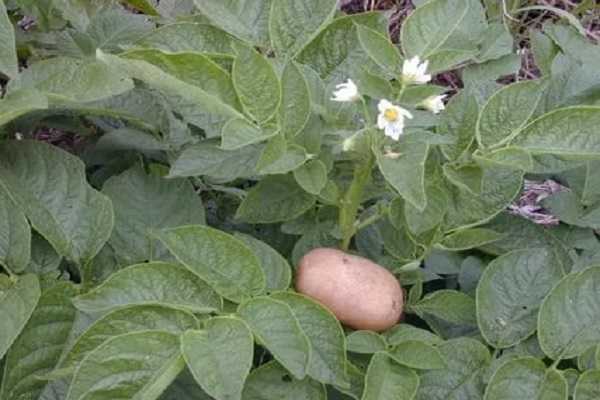
The plant is medium-sized and semi-upright. The leaves are small, dark green, and the inflorescences are purple. Each plant produces 10-15 buds. Potatoes do not respond well to dense planting. Despite their medium size, it is important to maintain a strict planting pattern.
The yield of the Vector potato and the nutritional value of the tuber
The Vector potato variety is renowned for its abundant yield, with up to 15 high-quality fruits being harvested from a single plant. The average yield per hectare is 45 tons, rising to 70 tons per hectare in ideal weather.
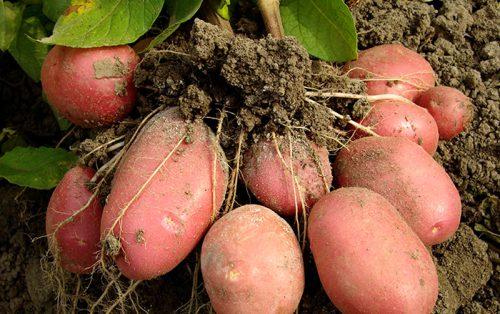
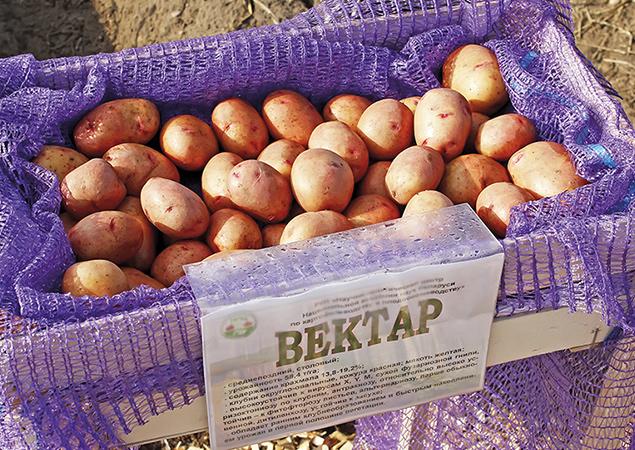
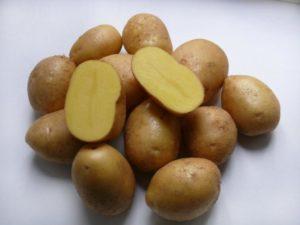
The tubers are medium-sized, pinkish, oval.
Each potato weighs 120 grams. The eyes are shallow and few in number, and the skin is brownish and dense. Tasters rated the variety's flavor excellently, giving it a 4.6 rating. The flesh, although firm, is juicy and does not darken when cooked. For this reason, the variety is used for all culinary purposes. The potatoes tend to overcook slightly when boiled, but they make excellent chips. The vegetables store well, with a maximum of 5% loss of quality over the winter.
Advantages and Disadvantages
The Vector potato variety has many strengths, but there are also some negative aspects.
| Pros | Cons |
| High yield | There is a lot of starch in the composition, therefore the potatoes are boiled soft. |
| Resistance to diseases and bugs | Mid-late ripening period |
| Drought resistance | |
| Excellent taste | |
| Easily survives transportation |
Step-by-step instructions for growing potatoes
After selecting the seedlings, they are placed in boxes and germinated. To speed up the emergence of the first shoots, they are covered with sawdust and watered with settled water. Three days before planting, the tubers are warmed up. They are then moved from storage to outside, closer to the sun.
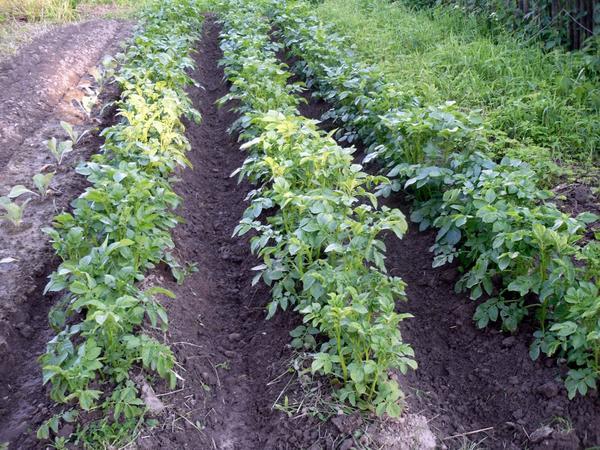
Potato planting scheme next:
- the distance between holes is 25-30 cm;
- between beds – 70 cm.
The hole depth should be 15 cm. If potatoes are planted in the South, the depth should be up to 10 cm. In the North, it should be 15 cm.
What size potato tubers should be for planting?
The success of potato growing depends on the health of the tubers. The seedlings should be the size of a chicken egg. When sowing seeds, the ideal shape is considered to be smooth, without any bends or kinks. Each seed should be free of any signs of bug or disease damage. For propagation, it's best to leave potatoes with plenty of buds.
If seeds are purchased with sprouts, do not break them off. This will reduce germination.
To accelerate seed germination, the tubers undergo pre-sowing preparation. The most important step is germination. Potatoes are placed in boxes or on a flat, dry surface in a single layer. After 7-10 days, sprouts will appear. Germination is even more rapid if the seeds are placed in damp sawdust, watered occasionally. Two to three days before planting, the tubers are warmed in the sun.
Selecting and preparing a planting site
Potatoes prefer to grow in sod-podzolic and bog-peat soils. Good drainage is essential, otherwise the risk of rhizome rot increases. The optimal pH level is neutral or slightly acidic. Potatoes grow well in black soil or sandy loam. The site should be well-lit, but the vegetable can also thrive in partial shade. The sites are prepared in the fall by digging the soil and adding organic matter: 3-4 kg of humus and 100 g of wood ash per square meter. When planting, add 15 g of double superphosphate, 12 g of potassium sulfate, and 10 g of urea to the hole..
Timing and technology of planting potatoes
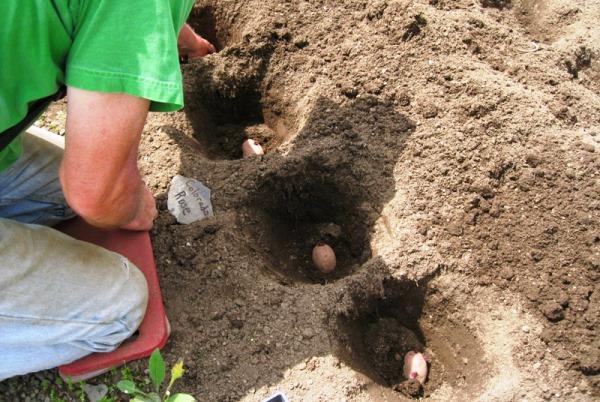
Potatoes are planted in late April or early May. The selected area is plowed again, and beds are formed at 40 cm intervals. The tubers are planted at a depth of 30 cm, pointed upward, and covered with a 10 cm layer of soil. This will speed up the potato growth, as the soil allows oxygen to pass through. The holes are filled, the rows are leveled, and the soil is raked.
Nuances of plant care
Caring for Vector potatoes is easy. Standard care includes timely watering, fertilizing, hilling the beds, loosening the soil, and mulching. You should also treat the plants for diseases and harmful bugs.
Watering and fertilizing the Vector variety
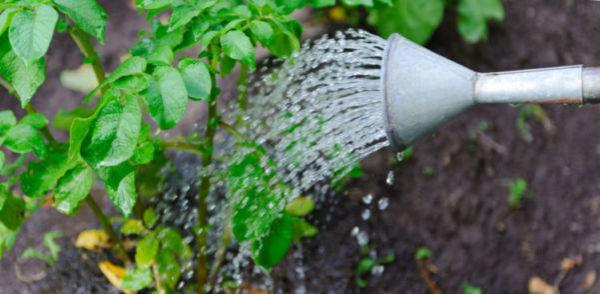
To obtain a decent harvest, 4-5 waterings are required during the growing season. The first watering is done after the tops have formed, when they rise 15 cm above the surface. The second watering is done after the flowers have formed. The third watering is done after flowering. The final watering should be light, half a bucket per plant. Otherwise, the risk of late blight increases.
Fertilizer is added in several stages. The first time is after planting. Dissolve 1 liter of chicken manure or 1 tablespoon of urea in 10 liters of water. Water 0.5 liters under each bush. This procedure is carried out after loosening the soil.
If the crop is poorly developed and the leaves are small, fertilize it in 3 stages.
- Before flowering, add 1 tablespoon of potassium sulfate per 10 liters of water.
- During budding, 1 tablespoon
- During flowering, 1 tablespoon of double superphosphate per 10 liters of water.
Each plant requires half a bucket of fertilizer. You can also sprinkle a dessert spoon of urea under the potatoes.
Loosening and mulching the soil
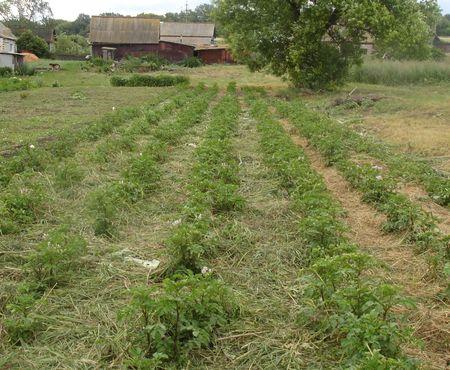
The soil is loosened before and after planting. When the first shoots appear, weeding is carried out to a depth of 5 cm. This procedure is also necessary when plants begin to grow rapidly and a large number of weeds appear. The soil is further loosened during periods of stagnant soil and after heavy rainfall.
Hilling potato beds
Potatoes are hilled twice during the growing season.
- The first time, after the tops reached 20 cm in height.
- The second hilling is done as the tops grow, usually 21 days after the first procedure.
Hilling prevents the tops from being pressed into the soil and removes weeds. This process loosens the soil, enriching it with oxygen.
What diseases and bugs are dangerous for Vector potatoes?
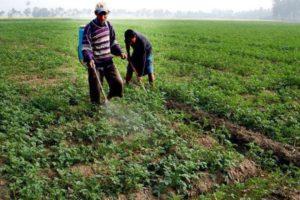
Vector potatoes are renowned for their resistance to late blight, viruses, scab, Alternaria, and canker. Sometimes, plants are susceptible to stripe and rugose mosaics, as well as leaf curl. Among the harmful beetles, the golden cyst nematode attacks. Preventative treatment can help prevent these problems. It's carried out as follows:
- carefully select seeds before sowing;
- adhere to planting patterns to prevent plants from becoming too dense;
- spray the bushes with special preparations to prevent fungal infections;
- observe crop rotation.
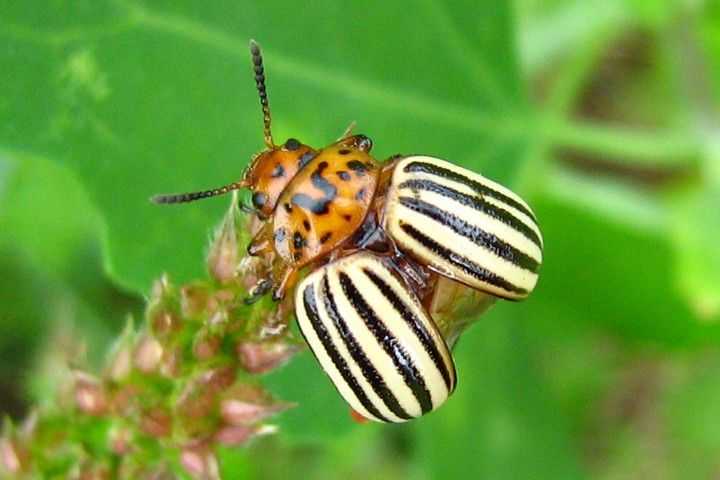
The Colorado potato beetle often attacks potatoes of any variety and is controlled by insecticides and hand picking. Wireworms, slugs, and mole crickets can cause more damage. They are controlled by setting traps and using insecticides.
How to properly harvest and store crops
Potatoes are harvested around mid-September, depending on when they were planted. This date marks the 3.5-month period from which they are harvested. Since the potatoes have a thick skin, mechanical harvesting is possible. To preserve their original appearance, they are air-dried for three hours before storage. The potatoes are stacked carefully, selecting the best quality ones first. They should be stored in wooden boxes, in a basement or cellar.
Vegetable growers' reviews of the Vector variety
Reviews of the Vector potato are positive and reflect the true description of the variety.
Matvey Revunov, 50 years old, Armavir.
Hello everyone! Vector is my favorite potato variety. I've been growing it in my garden for three years now for personal consumption. I love making mashed potatoes, casseroles, and roulades with the fruit. The bushes have been attacked by Colorado potato beetles twice, but I've managed to kill them with insecticides.
Ivan Romanov, 60 years old, Bataysk.
Hello! My neighbor treated me to Vector potatoes in 2015. He liked the puree so much that he started growing it at his dacha. I highly recommend this delicious, easy-to-grow potato to everyone.
Related posts:
 Description of the best potato varieties of domestic and foreign selection
 Description and characteristics of the Rodrigo potato variety, cultivation and care
 Description and characteristics of the Krasavchik potato variety, planting and care
 Why potatoes aren't growing well in the garden, and what to do to ensure a bountiful harvest
 Description of the best potato varieties for 2025, selection for regions
 Description and characteristics of the Sante potato variety, planting rules and care
 Description and characteristics of the Gulliver potato variety, planting and care
 Description and characteristics of the Bellarosa potato variety, planting and care