
- The history and regions of cultivation of the Sudarushka strawberry
- The main advantages and disadvantages of the variety
- Varietal features and characteristics
- Bush size
- Appearance of the leaf blade and tendrils
- Flowering and pollination
- Ripening time and yield
- Methods for prolonging fruiting
- Taste qualities of the fruit and its further sale
- Resistance to subzero temperatures and drought
- Susceptibility to diseases and parasites
- Specifics of planting berry bushes
- Site selection and preparation
- Selecting seedlings
- Timing and technology of planting seedlings
- How to care for garden strawberries
- Watering mode
- Top dressing
- Weeding and loosening the soil
- Mulching
- Caring for bushes after harvesting
- Protecting plantings from spring and winter frosts
- Preventive treatments against diseases and pests
- Methods of reproduction
- Seeds
- By dividing the bush
- Sockets
- Gardeners' reviews of the variety
The Sudarushka strawberry variety has long been popular among gardeners. This is due to its excellent adaptability to sudden weather changes. The berries are quite large and rarely affected by pests and diseases. The taste of the strawberries is excellent.
The history and regions of cultivation of the Sudarushka strawberry
This hybrid was developed by crossing the Festivalnaya and Roksana varieties in the Leningrad Region. It has been registered since 2000. It is widespread in the north and west. The berry is grown in Russia, Ukraine, Belarus, and the Baltic states. It is a fairly early variety that inherits the best characteristics of its parents.
The main advantages and disadvantages of the variety
The advantages of the Sudarushka strawberry are:
- Resistance to many diseases.
- Excellent taste.
- High yield.
- Strawberries cope well with drought.
Although it is rarely affected by pests, it copes poorly with them.

Varietal features and characteristics
By crossing two strong varieties, gardeners have created Sudarushka. Its characteristics are impressive, as most of them are at a high level.
Bush size
The bush is strong, dense, and spreading. The runners are formed moderately. The diameter of the bush ranges from 20 to 40 centimeters.
Appearance of the leaf blade and tendrils
The tendrils are not very long and grow moderately. They are light green or greenish-brown in color. Sometimes, pale pink tendrils are found. The leaf blade is umbrella-shaped and small. The underside is covered with small, fluffy hairs. The leaf is dark green. The sides of the leaf have rounded teeth.

Flowering and pollination
Unlike other fruit crops, strawberries don't stop growing in the fall, but only with the arrival of winter. As soon as the soil begins to warm, the plant revives. This means that Sudarushka has resumed growth. Sixteen days after awakening, the buds gradually open, and 20 days later, flowering begins. This period lasts another 18-20 days.
This period depends on weather conditions and ambient temperature. The flowers are white. There are usually 5-6 flowers per cluster. Pollinators are insects.

Ripening time and yield
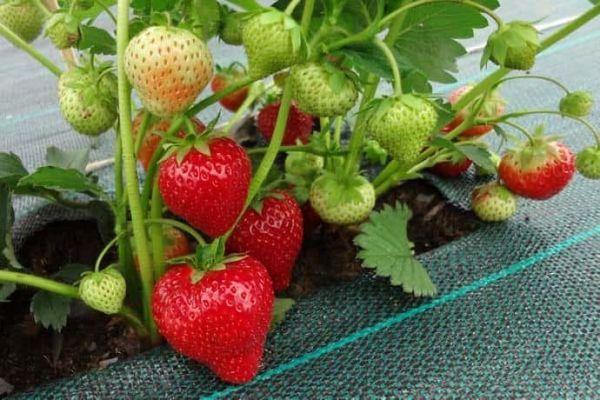
The Sudarushka variety has a medium ripening period. Berries begin to be harvested around June 20th-30th. Depending on the location and weather, these dates may vary and be delayed by 2-3 weeks.
In warmer places, strawberries ripen at the end of May.
Methods for prolonging fruiting
Sudarushka finishes fruiting within a month. There are currently several ways to extend or accelerate the ripening period. Film covering is used to speed up the process.
Work is carried out before the snow melts. The plantation or individual bushes are covered with black film. This will increase the temperature and cause the snow to melt quickly. As soon as the leaves emerge, the black film is removed and replaced with clear film. It is stretched only over the arches; the leaves should not touch, otherwise sunburn will occur. This method speeds up the process by 12-13 days.
If ripening needs to be delayed, another method is used. The plantation is covered with straw. The soil will not warm up quickly, so the ripening period will be delayed by 10 days.
Taste qualities of the fruit and its further sale
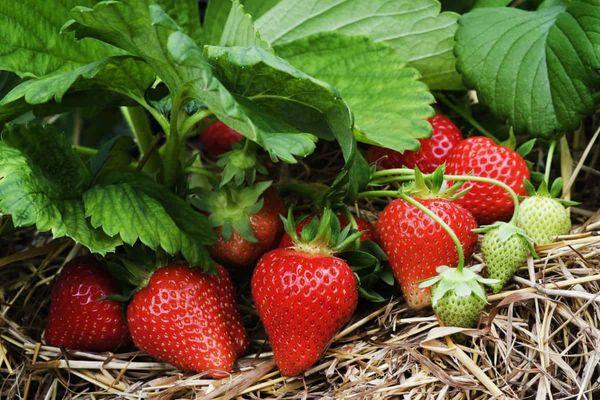
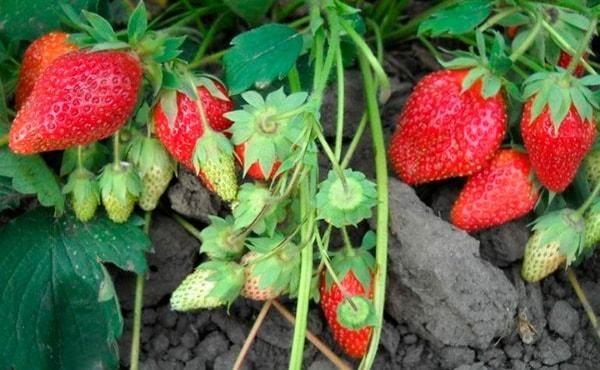
The fruit is ovoid and round, with numerous seeds. The average berry weight is 11 grams. The flesh is pink, very juicy, and firm. It has a pleasant strawberry aroma. Experts rated its flavor at 4.5 out of 5. The aftertaste is sweet and sour. Strawberries are great for making preserves, jams, juices, compotes, or simply freezing for the winter.
Resistance to subzero temperatures and drought
The Sudarushka strawberry variety tolerates frost and drought well. It can survive for long periods without water, but regular watering is essential for the plant's health.
Susceptibility to diseases and parasites
The hybrid is resistant to many diseases, but is susceptible to pest attacks. Therefore, annual preventative treatments are recommended.
Specifics of planting berry bushes
To get the maximum yield from a bush after planting, it's important to know the basic rules. This will increase the gardener's chances of having a healthy plant.
Site selection and preparation
The Sudarushka strawberry variety requires light, so choose well-lit sites for planting. Black soil is best. Planting is done in late August or early September. Fertilize the soil with peat before planting. If the soil is poor, postpone planting until spring, and at the end of the year, fertilize the soil with organic mixtures and mulch well.
Selecting seedlings
Strawberry seeds are either collected in advance or purchased. In this case, planting can be delayed. If you plan to plant strawberries from roots, do so immediately after purchasing the planting material.
The roots can be stored for several days by wrapping them in a damp cloth and storing them in a cool place.
Timing and technology of planting seedlings
Planting is done during the warmer months: early fall or spring. First, dig holes 6-8 centimeters deep. Moisten the holes first. Then, place the bush in the ground and bury it.


There are 4 methods used for planting the Sudarushka strawberry variety:
- Method 1 (carpet): This method is used without trimming the runners. This creates a natural layer of mulch. Gardeners don't have to loosen the soil or trim the runners. However, this method has a drawback: the strawberries will be small.
- Row planting: the most popular method. The bushes are planted in a single row, 35-40 centimeters apart. The soil must be constantly loosened. Strawberry runners are also removed.
- Planting in bushes yields a high yield and large berries. However, it is necessary to loosen the soil, remove runners, and control weeds.
- Planting in nests: create a hexagon of plants, then plant another bush inside it. The advantage of this method is its high yield.
How to care for garden strawberries
The quality of care for the crop will affect the further growth, development and yield of Sudarushka.

Watering mode
The berry requires ample watering. In hot weather, water the strawberries either in the evening or early in the morning. Otherwise, the leaves may burn.
Top dressing
In spring, Sudarushka strawberries are fed with nitrogen fertilizers. Chicken manure and saltpeter are used for this purpose. These nutrients are absorbed with each watering. Before flowering, the strawberries are fed with potassium fertilizers.
Weeding and loosening the soil
From time to time, all weeds in the area around Sudarushka are removed. The soil is loosened to prevent water stagnation and allow the roots to breathe.
Mulching
Depending on the planting method, loosening and weeding will be done more or less frequently. After the planting is covered with mulch, the crop is expected to grow. Cover the plant with straw, sawdust, or peat. After this, rodents will stop visiting the plantation.

Caring for bushes after harvesting
During the fruiting period, the plant loses a lot of energy. After harvesting, strawberry bush care begins. First, trim off old foliage and unnecessary tendrils. Young tendrils are left, which will act as seedlings.
This is done at the end of July. Afterwards, the plants are treated with strawberry mite control agents. The beds are weeded. The soil around the bushes is loosened to a depth of 8-10 centimeters. Then, the plants are fed again with organic fertilizer.
Protecting plantings from spring and winter frosts
When frost sets in, stop loosening the soil and weeding the beds, as the airy soil allows the cold to better reach the root system. Exposed roots are covered with soil. Diseased and weak bushes are also destroyed.

The strawberries are covered with leaves, sawdust, and dry straw. If there is little or no snow in the winter, the Sudarushka is covered with additional materials, such as agrofibre, spruce branches, or film.
Preventive treatments against diseases and pests
In warm weather, strawberries are treated with weevil preventatives such as Akarin and Iskra-bio. To kill the fungus, fungicides or copper-containing substances (such as Bordeaux mixture) are used.
Methods of reproduction
Propagating strawberries is easy. Common methods include seeds, rosettes, and division.
Seeds
Seeds are sown in small containers with lids. Later, the small seedlings are transferred to individual cups. Peat pellets can also be used. Seeds are sown in February or March.

To speed up germination, seeds are pre-soaked. The soil for planting should be light and crumbly. The soil is warmed and left to rest for 2-3 days. Then, plant.
By dividing the bush
This method is inexpensive; all you need to do is divide the existing bush into several parts. Each part should contain 2-3 shoots with leaves and tendrils, which are planted in the prepared area in the spring. The resulting seedlings will be very strong and productive. But if the strawberry is sick, this method will not work, since the disease will also spread to the seedlings.
Sockets
The most popular method of propagation is by runners. By selecting the best runners after the growing season, you can grow strong bushes from them. In this case, there's no need to prepare seeds, and the bush has a better chance of survival, as it's separated from the main bush only after it's fully rooted.
Gardeners' reviews of the variety
Marina Rybkova: “We grow only this variety, as it is the most resistant to diseases and pests. We close it every year delicious strawberry jam"Sudarushka is undemanding, so it doesn't need any special care."
Natalya Igoreva: "Sudarushka is famous for its delicious berries, which is why my husband and I grow it. It's very sweet. We do maintenance in the spring and fall. We propagate only by runners, as it's easy, even though the berries are small."
Related posts:
 Description of the Florence strawberry variety, planting and care features
 How to grow strawberries at home
 Description of the everbearing strawberry variety Selva and cultivation technology
 Description and characteristics of the Vima Zanta strawberry variety, planting and care scheme
 The best varieties and cultivation of everbearing strawberries, fertilizing and propagation
 Description of the Holiday strawberry variety, cultivation and propagation methods
 Description and characteristics of the Korona strawberry variety, planting and care scheme
 Description and characteristics of the Zenga Zengana strawberry variety, planting and care