
Russia's territory includes several regions with distinct climatic conditions. However, even such an easy-to-harvest crop as onions requires timely harvesting. Therefore, when harvesting onions, it's recommended to consider the weather conditions of each region. In this case, it's worth considering when to harvest onions in the Urals, as well as how to calculate the ripening period for common varieties.
Climate features and variety selection
It's a known fact that the harsher the climate in the region where onions are grown, the earlier they are harvested. For this purpose, early-ripening varieties are selected.
Let's consider the main climate features in the Urals that influence the choice of plant variety:
- The region's conditions are characterized by a short summer (it is necessary to select quickly ripening varieties).
- On average, the air temperature in summer does not exceed 23 degrees Celsius (varieties that do not require a hot climate are selected).
- High air humidity is regularly present (it is necessary to select onions for the Urals that are resistant to excess moisture).
- Long winters and plenty of snow (allows for planting winter onion varieties that take a long time to ripen).
- Lack of sunlight (due to the lack of ultraviolet radiation in the Urals, improved varieties of onions are used).
The Ural climate is not ideal for growing crops. Special onion varieties resistant to these harsh weather conditions are required.
Due to the climatic conditions present in the Urals, even such an unpretentious crop as onions requires special attention when choosing, as well as timely harvesting.
Beginner mistakes
When growing crops in the Urals, inexperienced gardeners often make mistakes that result in crop failure or poor growing conditions. The following are among the most common mistakes:
- Frequently used and unpretentious onion sets need to be harvested on time, before excess moisture and cold weather sets in (the crop is grown for two years);
- when grown, the heads protrude from the bed (due to the climate in the Urals, the fruits should be planted deeper into the soil);
- the period for digging up turnips, a common variety of the plant (this variety is an early ripening variety), has been disrupted;
- cleaned up family onion is not dried before placing it in a special storage facility (undried fruits may rot).
If you avoid the typical mistakes of inexperienced gardeners, it is possible to harvest and preserve a high-quality crop even in the unfavorable climatic conditions of the Urals.
The weather in this region does not favor residents with an abundance of warmth, so even the cultivation of unpretentious crops requires special attention.
We are deciding on the deadlines
Onion harvesting in the Urals must be done strictly within the established timeframe, otherwise there is a risk of ruining the entire crop. To determine the timing, the following is required:
- recommendations regarding the crop growing period are taken into account;
- weather forecasters' forecasts for the current summer are taken into account;
- The moment of planting vegetables in open ground is kept in memory.
When the ripening period arrives, one of the fruits needs to be checked for ripeness.
Before harvesting, select a less mature bush and dig it up. This will determine the ripeness of all the remaining bushes on the plant.
Mathematical calculations
Experienced gardeners claim that 70-75 days are sufficient for growing vegetables in the Urals. This calculation doesn't include the months of January, February, March, August, September, and October, as these periods experience the most unfavorable climate.
The periods of time when the weather is warmest and humidity is lowest are taken into account. Onions are typically planted outdoors starting on May 10th and harvested around the end of July 20th. This timeframe allows for the harvest to ripen.
If you are forgetful, then you use a calendar to accurately calculate the period for collecting ripe fruits.
Weather conditions
Rainfall is common in Siberia. This heavy rainfall has an adverse effect on onions. Therefore, planting begins immediately with the first warm weather in May. Unlike other regions, prolonged rains can begin in the Urals in August, ruining the entire harvest. Because of this, planting and harvesting are carried out earlier than in other regions of the country.
The unusual weather conditions found in the Urals require gardeners to be careful when growing vegetables, as any mistake can cost them their winter supplies.
External parameters
When crops ripen, the fruit's appearance is a guide. Let's look at the main signs of ripe onions in the Urals:
- the lower parts of the bush stems begin to turn yellow;
- large turnip heads can be seen poking out from the ground;
- the leaves of the bushes acquire a yellow tint;
- The husk on the pulled out head is easily removed and rustles.
If these signs appear, this is a clear signal for the upcoming harvest.
Is it possible to speed up the ripening process?
In practice, a gardener can speed up the ripening process by taking the following steps:
- It is necessary to raise the bushes above ground level by carefully digging up the plant from below with a shovel.
- Forced bending of plant bushes to the ground (carried out carefully so as not to damage the stem).
- You can speed up the ripening of onions by feeding them (in the Urals, onions are fed with special nutrient mixtures).
It is not recommended to dig the bushes out of the ground completely, as this may disrupt the onion growth process.
Cleaning Features
Ural gardeners offer some harvesting tips for beginning gardeners:
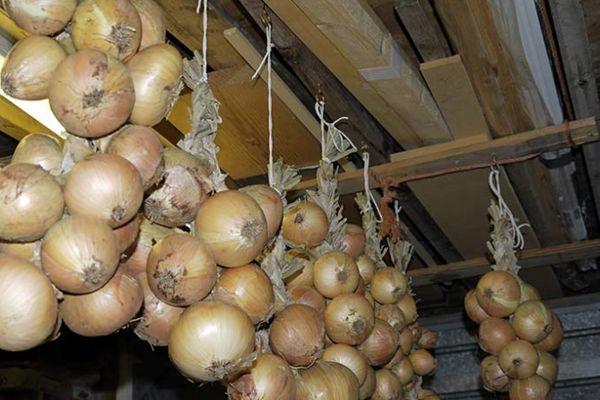
- After harvesting, the fruits must dry out; for this purpose, a well-ventilated room is used.
- There is no need to separate the tops from the main fruits, as they contain nutrients.
- Onions are stored in a storage facility where favorable conditions exist and where there are no significant temperature fluctuations.
- To store onions in the Urals, you need to select a room where there will be no high humidity.
If late-season onion varieties are used, careful harvest timing is required to prevent the plants from being caught by the first frosts, which in the Urals can occur even at the end of summer.
Related posts:
 When to harvest leeks from the garden for storage, ripening times
 50 types and varieties of perennial onions with descriptions, cultivation, and care
 Description of the best varieties of onions, planting and care in open ground
 How and when to plant onions to get large bulbs
 The beneficial properties of white onions, description of varieties, cultivation and care
 Description of the Exhibition onion variety, growing from seedlings, planting and care
 Description of varieties and cultivars of wild onions, the subtleties of cultivation
 When to harvest onions planted in autumn and spring from the garden for storage, how to determine the timing
Take a look Also
Last year we had a good harvest of onions and used a growth activator. BioGrowThis year we also used it to fertilize our peppers. We've never had such large peppers before, and we dug up some onions to try them out, and the bulbs are gorgeous too!