
Folk remedies for protecting onion crops from pests are inexpensive, safe, and effective. The most popular are ammonia, saline solutions, and wood ash. Watering onions with salt is used to protect against onion flies. This inconspicuous insect, belonging to the order Diptera, causes serious damage to onions and other bulbous plants. However, when using a saline solution, it is important to follow the recommended proportions to avoid harming the plants and the soil.
Signs of defeat
Onion fly has a wide distribution range. During the summer, an adult female can produce two generations of insects, and under favorable weather conditions, three. It's not surprising that the scale of damage it causes is quite extensive. Onion flies affect not only onion crops, but also leek, garlic, tulips, gladioli and other plants with bulbs.
The main damage is caused by insects in the larval stage (nymphs) – small white worms, up to 10 millimeters in size, with black hook-shaped jaws. They are extremely voracious and often destroy entire crops.
The initial signs of damage to onion plantings appear in June, when the first pest hatches.
Affected plants can be identified by their appearance: the tips of the onion leaves turn yellow and curl, the bulbs stop growing, become soft, and develop a putrid odor. Motile white worms can be seen under the outer scales of the turnips.
What harm does it cause?
Onion fly emergence begins in late May or early June, after onion and garlic planting is complete. Adult insects lay underground clutches of eggs in close proximity to the garden beds, each containing 5 to 20 eggs. Adequate soil moisture is essential for the embryos to thrive.
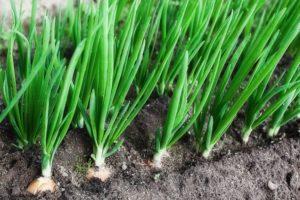

After 7-10 days, the larvae hatch from the eggs. Their main characteristic is their enormous voracity. Sticking together, they burrow into the root crop and completely consume the juicy flesh. They then move on to neighboring ones, gradually destroying everything. After 2-3 weeks, pupation begins. The larvae emerge into the soil and form pseudococoons, in which the insects of the next generation develop. The development period lasts 2-3 weeks. Then, young flies emerge from the pseudococoons, and the process of growth and reproduction repeats.
The insects overwinter in the soil, at a shallow depth. In early spring, a mass of mature pests emerge, ready to mate and lay eggs. Planting onion or garlic seedlings in infested soil can completely destroy the harvest.
Ancient recipe
It has long been known that adding small amounts of sodium chloride to the soil is an effective way to combat onion fly. To kill the pest, onion crops were watered with a specific proportion of a water solution of table salt. For effective disinfection, the treatment was carried out in three stages, with the salt concentration slightly increasing each time:
- first treatment – 300 grams of salt per 10 liters of water;
- second treatment – 450 grams of salt per 10 liters of water;
- third treatment – 600 grams of salt per 10 liters of water.
 Plant tubers placed in a thick salt solution become inedible to insects. Sodium chloride crystals are also lethal to larvae. However, it's crucial to ensure that the salt concentration does not exceed the recommended values when preparing the solution.
When to water
Watering onion plantings with a saline solution is effective if the onion fly infestation is not severe. In severe cases, professional insecticides are used.
Plant treatment should be done in the evening, after the heat has subsided.
The solution is prepared immediately before use. A certain amount of rock salt is dissolved in warm tap water. Apply the solution by thoroughly watering the root zone of the plants, avoiding the above-ground, green parts. After the solution has been thoroughly absorbed (2-3 hours after application), the beds are watered generously with clean water to wash away any remaining crystals.
![When should onions be harvested in [year] in the Moscow region from the garden for storage?](https://harvesthub.decorexpro.com/wp-content/uploads/2018/07/uborka-luka-8-300x200.jpg)

The procedure should be performed three times per season, at intervals of 2-3 weeks. The effectiveness of the treatments is checked by lightly digging around the roots and inspecting their condition.
First watering
The first watering of the plantings with a saline solution should be done when the onion leaves reach a length of 7-11 millimeters. This is when the pest begins to hatch. Newly hatched larvae are most vulnerable and susceptible to destruction.
Second
The beds should be watered with salt a second time in about three weeks. The concentration should be slightly higher. This will effectively kill any larvae that survive the first treatment.
Third
While treating plants, monitor their condition. If signs of infestation have disappeared, the third watering can be omitted. If treatment is still necessary, repeat the procedure after two weeks, making an even more concentrated solution. Exercise particular caution when performing the third watering.

Between waterings, carefully tend to the plants. Regularly loosen the soil, remove dried and wilted shoots, remove weak and dead shoots, and fertilize the plants with organic fertilizer.
You should finish treating onion plantings with salt approximately a month before the time for harvesting.
For prevention
Treating onion crops with a sodium chloride solution is also effective in preventing onion fly infestations. Three irrigations, every 2-3 weeks, are also used as a preventative measure.
Salt is used in combination with mineral fertilizers as a fertilizer or stimulant, improving the absorption of nutrients. Soaking the seeds in a saline solution (one cup of salt per 10 liters of water) for 12 hours is also possible.

It's recommended to select a new location for onion beds each year. Infested soil should be dug over without breaking up clods. The larvae will rise to the surface and die during winter frosts.
How to avoid over-salting your garden beds
When watering onions with a saline solution, it's important to maintain the soil's quality. To avoid disturbing its chemical composition, follow the recommended dosage when preparing the salt water.

Excessive sodium chloride concentrations displace calcium from the soil. This slows seed germination, damages the root system, and disrupts the water balance of plant cells. In reasonable quantities, a salt-based product is an inexpensive fertilizer and an effective way to control insect pests.

Reviews
Oleg
"I read about the benefits of salt against onion flies. I decided to try the recipe in my garden. The number of dead plants this year was significantly lower. I was worried about a side effect of crushed bulbs. My fears were unfounded. The onions and garlic are growing large, with fleshy white flesh."
Eleanor
"I recently started planting onions and garlic. Onion fly larvae destroyed the entire harvest the first year. My grandmother advised me to use a salt solution for watering. The following year, we got high-quality, large tubers."
Related posts:
 How to control onion flies using natural and chemical methods
 Description of the best varieties of onions, planting and care in open ground
 50 types and varieties of perennial onions with descriptions, cultivation, and care
 How and when to plant onions to get large bulbs
 Control of onion pests using chemical and folk remedies
 Description of Welsh onion varieties, planting, growing, and care in open ground
 Description of varieties and cultivars of wild onions, the subtleties of cultivation
 The beneficial properties of white onions, description of varieties, cultivation and care