
Every second gardener grows onions in their garden. When growing onions, it's important to decide in advance when to harvest them. In central Russia, onions are typically harvested in late July or early August. However, there are several other ways gardeners determine the harvest time. When to harvest onions from the gardenTo preserve your harvest throughout the winter, follow the recommendations for proper harvesting and storage.
Peculiarities of harvesting onions
The timing of onion harvesting in temperate climates depends on many factors. Weather conditions and the appearance of the fruit are the primary factors. Growing onions can last the entire season if the first planting is done in early spring. Two harvests can be harvested in a single season if late-ripening varieties are planted early in the spring and early-ripening varieties in late spring or early summer.
Onions should be harvested only in sunny, windless weather. The soil must be dry so the bulbs can be easily removed. When harvesting, it's important not to tear the bulbs away from the foliage. While the bulbs are drying, the leaves will provide them with nutrients.
What does it depend on and how do you determine the timing?
The time to harvest onions in Russia depends on a number of factors. These include:
- climatic conditions of the region in which the vegetable grows;
- timing of planting sets in open ground;
- the fertility of the soil in which the vegetable grows;
- duration of the growing season.
Determining the right time is easy if you know the exact planting date. External signs are another factor that can help you determine whether it's time to dig up the crop. The key is to dig up the harvest before prolonged rains begin. Otherwise, the entire crop will be lost.
By external signs
Onion harvesting in Siberia is no different from harvesting in other regions, except for the southern ones. In central latitudes, harvesting times are almost the same, with a few days' difference. It's easy to tell when to dig up the bulbs by their appearance:
- the neck of the bulb turns yellow and dries out;
- feathers spread along the soil (more than half of the leaves should lie on the ground);
- onion greens turn yellow and dry out;
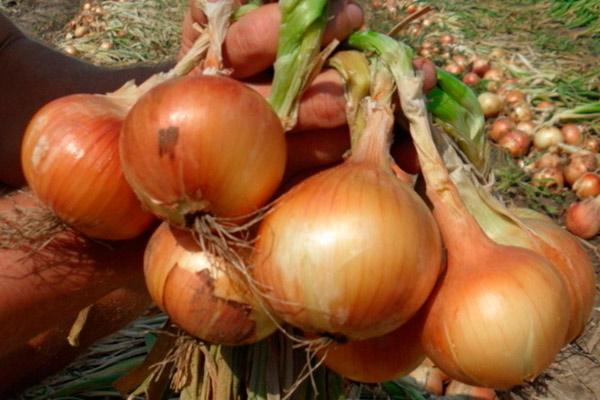
- The bulb is covered with golden scales, which are easily separated from the head.
If all of these signs are present in your onion bed, it's time to dig up the bulbs. Do this carefully to avoid damaging the necks.
If the plumes don't turn yellow, the ripening process should be accelerated. To do this, lightly pull out the bulbs while weeding the beds, so that a small portion of the roots breaks off.
Mathematical method
To understand, When to harvest onions, a mathematical method must be applied. It allows the harvesting time to be calculated with precision down to the last day.
To calculate the ripening date of onion sets, remember the planting date and then add 70-80 days to it. This date will be the time to dig up the bulbs from the plot. However, blindly relying on this method is not recommended. In addition to the calculation, weather conditions should be taken into account. The growing season also needs to be taken into account, as it varies for different varieties:
- the early ripening variety has a ripening period of 90 days;
- mid-season variety – 120 days;
- the late ripening period is 140 days;
- Late varieties ripen in 150 days.
Before digging, stop watering the beds well in advance. Typically, stop watering the beds two weeks beforehand.
According to the lunar calendar
Another method for determining harvest timing is the lunar calendar. In 2025, dates beginning on August 7th are considered favorable. However, in addition to the lunar calendar, the ripening period should be determined by external signs. Even if the lunar calendar indicates favorable harvesting and storage, but the onions are still green, the foliage hasn't begun to dry, or there is rain, digging should be postponed.
According to the lunar calendar, bulbs should be dug up during the waxing moon. During this period, all the nutrients are absorbed into the bulbs. The same applies to the waxing moon. The lunar calendar also advises against harvesting onions and other vegetable crops during the waning moon. Superstitious gardeners believe the harvest will not store well.
The dangers of untimely harvesting of onions
It's important to harvest your onions on time. After planting the onion sets, it's important to find out when most gardeners harvest their onions. If you start digging up the harvest too early, the scales will not have time to form and will not fit tightly to the bulb. This can lead to the onion quickly spoiling during storage. Furthermore, it's important to store the vegetable at a temperature of at least 13 degrees Celsius. If the temperature drops below this, the onion will freeze and spoil.
Vegetables should be harvested no earlier than July 20th. Most varieties won't have time to ripen before then. Signs of harvesting too early are immediately visible:
- a small amount of dry scales on the head;
- the basal collar is thick and green;
- the appearance of fungi on the bulbs.
If you harvest onions too early, the scales will fall off, roots will form on the bulbs, and the bulbs themselves will become affected by fungi and infections.
When to trim onions for storage
The onion sets are harvested from the garden bed only after more than half the foliage has begun to dry. The bulbs should be dug up in the morning. Some gardeners prefer to cut off the root collar immediately after digging. However, this is not recommended. The foliage should be left on for the first few days while the harvested onions dry.
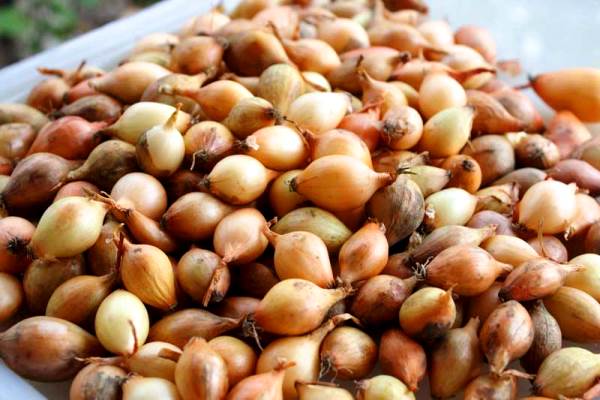
If the weather forecast predicts sunny weather in the next few days after digging, the vegetables are left in the beds for 3-4 days. However, the outside air should be dry. However, the vegetables should still be moved under cover at night.
During drying, check the heads regularly and rotate them. It's also important to trim the stems correctly:
- clear the heads of soil, but do not hit them against each other;
- trim the roots with a knife;
- trim the feathers, leaving 4 cm from the stem;
- After cutting off the heads, take them out into the sun for a day to dry.

Once the bulbs are completely dry, they are transferred to nets, wooden crates, or cardboard boxes. Unripe bulbs with thick root collars are useless for winter storage. They will spoil anyway. It is recommended to use such bulbs for canning or other dishes immediately after harvesting.
How to determine the ripeness of onions
Harvesting onion sets It will be successful if you know the signs of bulb maturity. These signs are the same for all varieties. Monitor the bulbs' appearance to determine when they are ripe. You should dig up the harvest if:
- the tips of the feathers turn yellow and dry out;
- the scales on the heads are easily separated from the bulb itself;
- most of the feathers lie on the ground;
- the root collar becomes thinner.
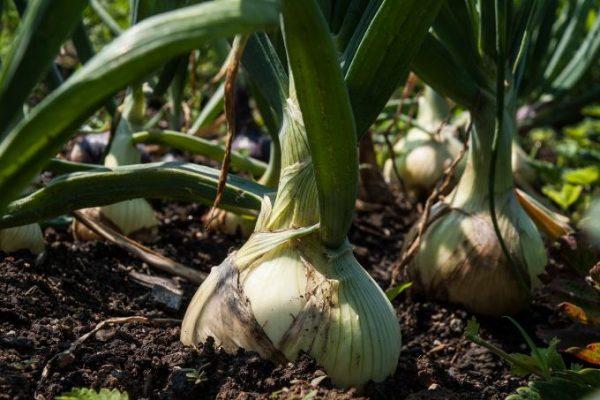
It's important not to over-harvest onions in the garden. If harvested late, the bulbs will develop roots and green shoots. This means the crop will not store well over winter. The best time to harvest, when the crop reaches biological maturity, is considered to be from late July to early September. The exact date depends on the variety.
Related posts:
 When to harvest leeks from the garden for storage, ripening times
 50 types and varieties of perennial onions with descriptions, cultivation, and care
 Description of the Exhibition onion variety, growing from seedlings, planting and care
 When to harvest onions planted in autumn and spring from the garden for storage, how to determine the timing
 Description of the best varieties of onions, planting and care in open ground
 Description of shallot varieties, cultivation and care, when to harvest
 Description of purple onion varieties, their beneficial properties, storage methods, and harvesting times
 The beneficial properties of white onions, description of varieties, cultivation and care