
- How is iodine beneficial for tomatoes?
- Helps in the absorption of nutrients
- Improves fruit quality
- Helps fight diseases
- Signs of iodine deficiency
- Methods of introducing fertilizer
- Root
- Foliar
- Recipes and proportions
- Spraying with milk
- Serum treatment
- Feeding with iodine and brilliant green
- Root feeding
- The nuances of preparing a solution for mature bushes and seedlings
- How to cope with illnesses
- Fighting late blight
- With powdery mildew
- Brown spot
- Gray rot
- Tobacco mosaic virus
- Fusarium wilt
- What to do if you overdid it with the dosage?
- Reviews from gardeners about the use
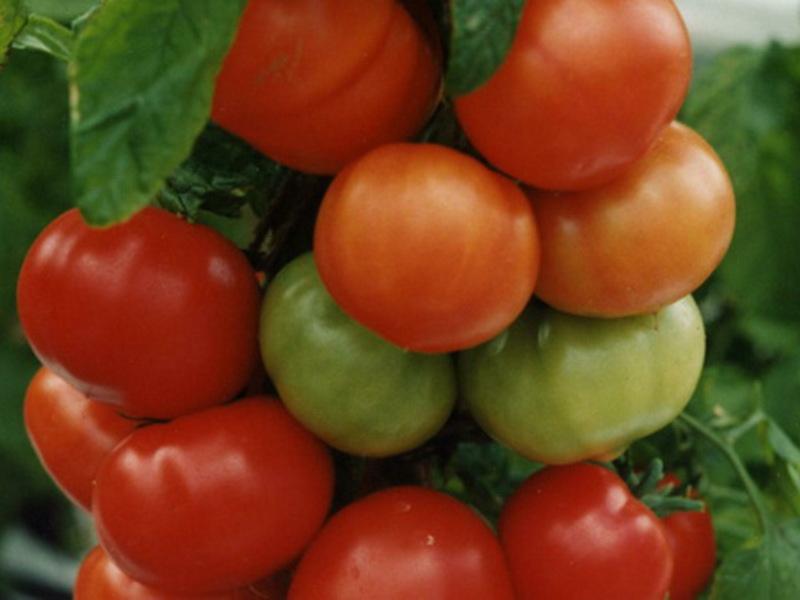
Many gardeners are interested in the benefits and technology of spraying tomatoes with iodine. This type of fertilizer is essential in many regions of Russia. Iodine deficiency has been identified in the soils of Tuva, Transbaikalia, the Urals, Chuvashia, and the Upper Volga region. Root and foliar applications provide tomatoes with this important micronutrient.
How is iodine beneficial for tomatoes?
During the growing season, physiological processes occur in tomato tissue. Iodine is involved in some of these processes (protein and amino acid synthesis, photosynthesis, and nitrogen metabolism). Gardeners wonder whether iodine tincture can be used in a greenhouse (or vegetable garden) to fertilize tomatoes. Not everyone understands why plants need it at all.
Helps in the absorption of nutrients
Iodine is not a fertilizer. The effects of this natural element on plants have been little studied. Gardeners have appreciated the product's role as a catalyst in nutrient absorption and have found that it activates plants' defenses.
Iodine is found in the soil as salts. It's abundant in chernozem, red soil, and chestnut soil. Deficiencies are observed in sierozem, solonetz, and brown soil. Knowing the soil type in your garden can help you determine whether your tomatoes need iodine supplements.
Improves fruit quality
Gardeners have noted that watering tomato seedlings with iodine improves the taste of the fruit. They ripen faster, and the buds open earlier. Iodine, found in the fruit's tissues, is beneficial for human health. It is essential for the normal functioning of the thyroid gland.

Helps fight diseases
The product is a powerful antiseptic. It has a strong bactericidal effect. The main uses of this pharmaceutical product in amateur vegetable gardening are:
- seed treatment;
- prevention of fungal and viral diseases.
Signs of iodine deficiency
There are no clear definitions of iodine deficiency in tomatoes. All conclusions are based on the observations of amateur vegetable growers. According to them, the following signs indicate the need for iodine supplementation:
- delayed fruiting;
- tomato bushes with thin stems;
- pale color of leaves;
- weakened, diseased seedlings;
- symptoms of fungal diseases that clearly indicate a weakened immune system.

Methods of introducing fertilizer
You don't have to wait long to see the effects of iodine tincture. Benefits are felt within a few days of application. Seedlings that received iodine during cultivation quickly take root when transplanted and grow rapidly when transplanted. It develops a strong root system and a powerful above-ground part.
Root
The first time tomato seedlings need to be fed at the roots is when they develop the second pair of true leaves. Root feeding is especially effective for seedlings growing in greenhouses. Follow this schedule:
- 10 liters of water are settled;
- dilute 10 g of iodine tincture;
- 500 ml of the resulting solution is used per 1 seedling.


A different recipe is used to feed mature tomato plants. First, prepare an ash infusion (3 liters of ash, 5 liters of boiling water) for 1 hour. Strain it into a 10-liter bucket. Add water. Add iodine tincture (10 ml) and boric acid (10 g) to the solution. First, dissolve the acid in hot water. This is a concentrated infusion. Use 1 liter per bucket of water. Water the plants at the roots.
Foliar
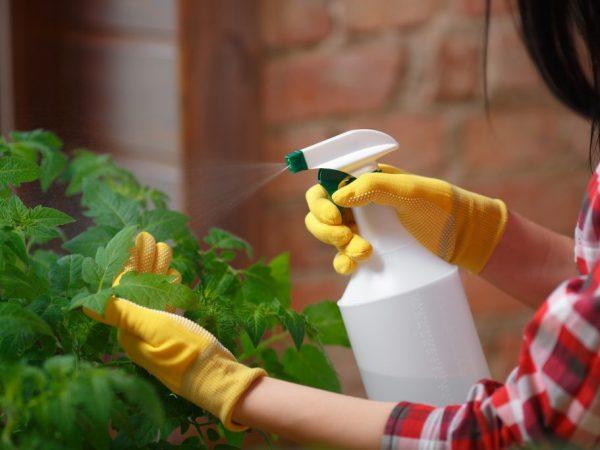
Root watering should be alternated with foliar spraying. Foliar feeding recipes are provided in the table.
| Seedling (adult bush) | Progress of work |
| 1 liter of warm water | Mix all ingredients and pour into a spray bottle. |
| 1 tbsp. milk (low fat) | Spray the leaves on both sides |
| 5 drops of iodine | Treatment should be carried out in the morning before 11:00 or in the evening from 17:00 to 19:00 |
Recipes and proportions
Every tomato lover should have a collection of folk remedies. The effectiveness of iodine can be enhanced with milk, whey, and brilliant green. All methods have been tried and tested.
Spraying with milk
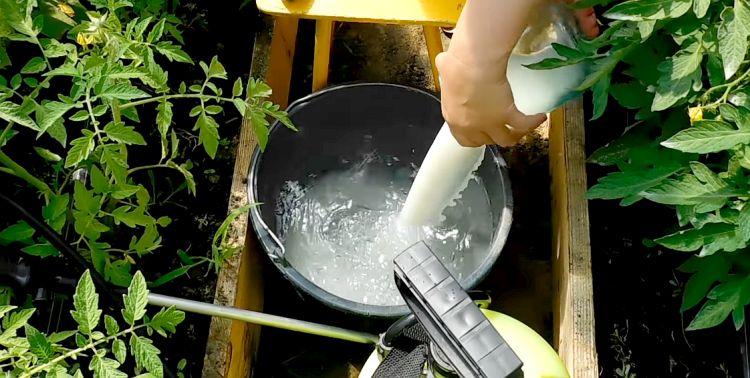
There's no doubt about the benefits of skim milk for tomatoes. It can be used to combat tomato pests. Insects don't tolerate its components well: milk sugar and lactose. Furthermore, spraying the milk solution creates a thin film on the surface of the leaves. This film protects the plant from fungal infections.
Concentrated milk should not be used. It will destroy the tomato plant. For nutrition and pest control, use this solution:
- water 4 l;
- iodine 15 drops;
- milk 1 l.
Serum treatment
Whey is obtained by curdling milk. It's acidic and contains trace elements that are beneficial for tomatoes:
- boost immunity;
- stimulate fruit formation.
An acidic environment inhibits fungal infections. In the garden and greenhouse, diluted whey can be used. For root feeding, prepare a solution of 10 parts water to 1 part whey.
For foliar treatments, use a more concentrated solution: 3 parts water, 1 part whey. To enhance the preventative effect, add 10 drops of iodine tincture for every 10 liters of solution.

Feeding with iodine and brilliant green
In August, the threat of late blight increases. It's hot during the day and cold at night. This weakens tomatoes. A folk remedy for spraying can help boost immunity. The recipe is as follows:
- warm water 1 l;
- brilliant green 4 drops;
- iodine 1 ml.
Root feeding
You can water tomatoes several times per season. Root feeding accelerates seedling development and their adaptation after transplanting. It's beneficial to water the soil with a solution of water, iodine, and milk after adding organic matter and to prevent powdery mildew.

The nuances of preparing a solution for mature bushes and seedlings
At different stages of development, solutions of different concentrations are used.
| Phase | Amount of iodine | Type of processing |
| Seed treatment | 0.1% solution | Soak |
| When the second leaf appears on the seedlings | 1 drop per 3 liters | Watering |
| When tying the 1st brush | 3 drops per 10 liters | Watering |
| Prevention of late blight | 40 drops per 10 liters | Spraying |

How to cope with illnesses
Any disease is easier to prevent than to cure. Preventative treatment of tomatoes with iodine tincture helps prevent epidemics caused by fungi.

Fighting late blight
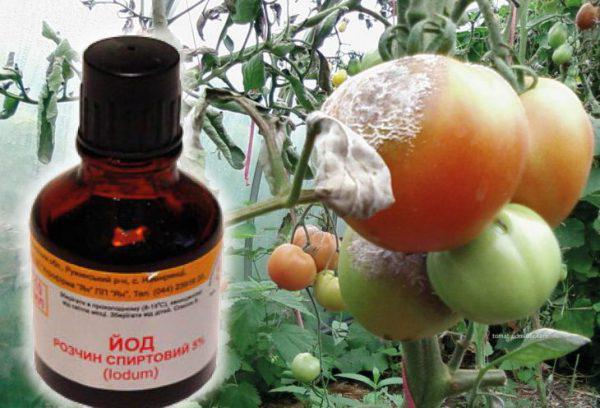
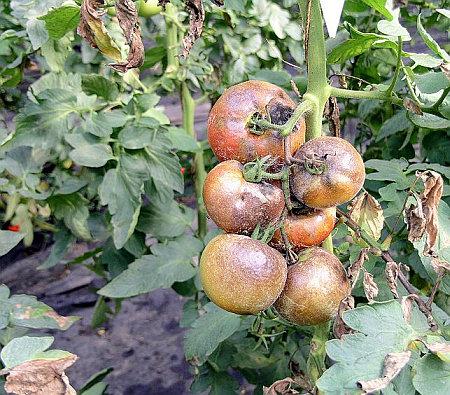
Phytophthora is a pathogenic oomycete microorganism. It can destroy entire tomato plants in a garden or greenhouse in a matter of days.
Late blight epidemics are provoked by rainy weather, large differences between night and day temperatures, and dense planting.
Tomato plants overfed with nitrogen often suffer from fungus. While it's difficult to cure, prevention is easier. An iodine solution can help. The bushes need to be treated with the preparation during the waxing moon. For greater effectiveness, add whey to the solution in addition to water. It forms a thin film on the surface of tomato leaves that is impermeable to fungal infections.
| Ingredient | Quantity |
| Water | 4 l |
| Serum | 1 l |
| Iodine | 15 drops |
When bad weather sets in, it's best to alternate iodine treatments with copper sulfate-based sprays. Copper-containing products can be used on greenhouse tomatoes and those grown in the garden. At least three preventative sprays per season are recommended.
With powdery mildew
Iodine and milk help eliminate powdery mildew pathogens. To prepare this folk remedy, take:
- 3 liters of warm, settled water;
- 350 ml low-fat milk;
- 4 drops of iodine.
This solution can be used to water the soil around the diseased bush and spray the leaves.
Brown spot
Cladosporiosis (brown spot) affects tomato leaves, affecting yield. If the infestation is severe and left untreated, the tomato plant may die from brown spot. Most of the leaves dry out and fall off, and photosynthesis is impaired.

The infection begins to manifest itself during flowering. It can be identified by light green spots on the leaves. When these spots appear, greenhouse and open-ground plants should be treated with the following solution:
- water 10 l;
- potassium chloride 30 g;
- iodine 40 drops.
Gray rot
In hot, humid weather, tomatoes are susceptible to B. cinerea. The fungus penetrates plant tissue through micro-injuries. The risk of infection increases during pruning. Cool, damp weather favors the spread of gray mold.
To prevent the disease, you can use a proven folk remedy with iodine and garlic. Treat seedlings with it before transplanting them into a greenhouse or vegetable garden. To prepare 1 bucket of garlic tincture, you will need 500 g of garlic (garlic arrows, cloves) and 30 drops of iodine.
Tobacco mosaic virus
There is no cure for this viral disease. Tomato plants displaying tobacco mosaic symptoms must be destroyed. Dig them up, roots included. Disinfect the soil. Treat adjacent plants with a solution of water (10 liters), milk (1 liter), and iodine (10 drops).
The disease is caused by the tomato mosaic virus, tobamovirus. It is spread through:
- soil;
- tools;
- seeds.

Symptoms of infection include spots of various shapes with a clearly defined border, curled and dried leaves, and light (green, whitish) spots on the fruit.
Take a look Also

Fusarium wilt
The onset of the disease is yellow lower leaves and curled leaves at the top. Greenhouse tomatoes are more often affected by fusariumWithout crop rotation in the greenhouse and soil replacement, fungal spores remain in the soil. They are activated by increased soil and air humidity, warm weather, and densely planted tomato plants. Fungicides (Quadris, Bayleton) are used for treatment, and folk remedies are used for prevention.
To spray tomato bushes, prepare solutions:
- in a 10 liter bucket of water dissolve 25 g of shavings of laundry soap, 35 drops of iodine, 1 liter of milk;
- In 1 liter of water, infuse a crushed head of garlic, add 1-2 drops of iodine;
- mix 1 part whey, 7 parts water.

What to do if you overdid it with the dosage?
Iodine's beneficial effects are observed when applied as directed. Violating the recommended dosage will result in deformed fruits and a deterioration in their marketability. Gardeners who use iodine as a fertilizer note that it's best not to apply root fertilization during fruiting. Stop applying it after the first ovaries appear.
Features of use:
- do not use the preparation within 2 weeks after transplanting seedlings into the ground;
- do not combine with Trichopolum and Aspirin;
- Fertilizing with boric acid and peroxide should be carried out 4 days after treatment with iodine solution.
Reviews from gardeners about the use
Olga Timofeevna, 47, Arkhangelsk Region: “I’ve seen the effectiveness of iodine in practice. I tried it on greenhouse tomatoes. I watered the soil under the bushes, adding one drop of iodine for every 3 liters of water. I poured 1 liter under tall bushes and 0.5 liters under short bushes. In August, I sprayed the leaves with a solution of the same concentration once every two weeks. I applied root fertilizer three times over the summer. The tomatoes bloomed well, and the ovaries didn’t fall off. There were no signs of late blight or other diseases on the bushes. The last tomatoes were harvested on September 10th. The greenhouse was treated with Farmayod in the spring. It’s a good antiseptic. It contains 10% iodine.”
Svetlana Vitalievna, 37, Bryansk: "Time is tight. We only go to our dacha on weekends. I want to relax, so I spend little time on gardening. Instead of foliar treatments, I put open bottles of iodine in the tomato greenhouse. There was no late blight this year. Maybe the iodine helped?"
Related posts:
 How to properly feed cabbage with iodine and processing methods
 Can iodine be used as a fertilizer for peppers and what are the rules for processing it?
 How to spray cucumbers with milk and iodine for fertilization
 Rules for treating and fertilizing cucumbers with brilliant green and iodine, and disease control
 What is the best way to feed geraniums at home? - a list of fertilizers
 The best eggplant varieties for growing in a polycarbonate greenhouse: planting and care
 What can you feed peppers with after planting them in the ground? Mineral and organic fertilizers.
 How to properly treat grapes with soda and potassium permanganate
However, if the bush is already infected with late blight, this method won't stop it; chemicals are needed. I often simply hang several open jars of iodine around the area as a preventative measure.