
- Description and Features
- Anapa
- Crimean
- Azos
- Black
- Lux
- History of selection
- Main characteristics of the variety
- Medicinal properties
- Caloric content
- Benefits and harms
- Acidity
- Berries and bushes
- Disease resistance
- Frost resistance
- Productivity
- Transportability
- Advantages and disadvantages
- How to plant
- Recommendations for choosing deadlines
- Site selection and preparation
- How to select and prepare planting material
- Planting diagram
- Care instructions
- Watering
- Top dressing
- Mulching
- Formation
- Preventive treatment
- Installation of the support
- Shelter for the winter
- Protection from wasps and birds
- Crop rationing
- Sanitary pruning
- Grafting cuttings onto an adult rootstock
- How to prepare cuttings
- Choosing a term
- Growth stimulator
- How to graft
- Diseases and pests
- Oidium
- Mildew
- Harvesting and storage
- Applications of berries
- Tips and advice from experienced gardeners
Cardinal is one of the finest grape varieties, combining both visual appeal and unrivaled flavor. Developed in America, it quickly gained popularity throughout Europe, including Russia. Below is information on growing Cardinal grapes, propagating them in the garden, and tips and recommendations from experienced winegrowers.
Description and Features
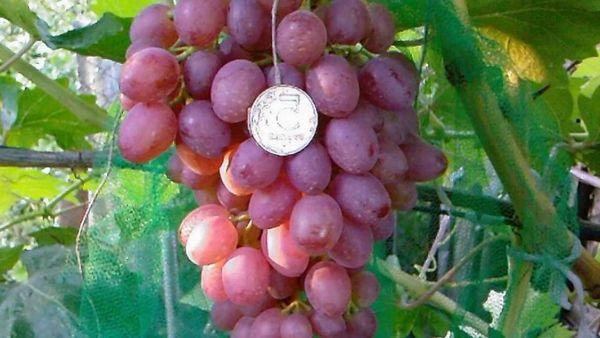
The Cardinal grape is an early-ripening table grape variety. The harvest is in August. The berries are oval or semi-oval, and their color ranges from red to purple. Several varieties have been developed from the Cardinal grape variety.
Anapa
The grape clusters weigh between 450 grams and 1 kilogram. The berries are sweet, with a muscat flavor, and are colored in a red-blue palette. Anapa grapes are recommended for cultivation in the North Caucasus region.
Crimean
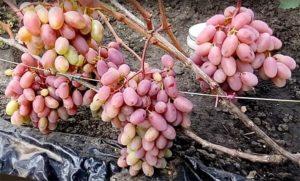
This is one of the early grape varieties: the berries ripen 100 days after bud break. They are large and pink in color. The grape clusters require protection from birds.
Azos
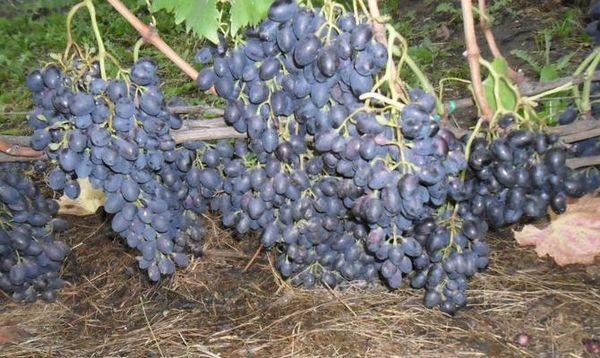
The Azos grape variety was developed by crossing the Cardinal and Criulyansky grapes at the Anapa Zonal Station of Horticulture and Viticulture. It inherited the best qualities of its parents: early ripening and flavor from the former, and disease resistance and high yield from the latter. Azos grapes are red or dark blue in color, covered with a waxy bloom.
Black
The grape gets its name from its dark blue, almost black berries. The grape clusters are highly marketable: they reach 15 centimeters in width and 30 centimeters in length, and consist of large, oval-shaped fruits.
Lux
This early-ripening table grape was developed from the Cardinal and Criuleni varieties. The harvest ripens 125 days after bud break. The sweet berries are red or dark blue in color and contain 21% sugar. Lux is another name for the Azos variety.
History of selection
Cardinal was developed in the 1930s in California by crossing Queen of the Vineyards and Alphonse Lavallee. The variety quickly gained popularity in Europe. It was brought to Russia in 1958, but was not added to the State Register until 1974. Several subvarieties have been developed from the Cardinal grape.
Main characteristics of the variety
Cardinal ripens in 105-120 days from the start of the growing season. Tasters gave the berries a score of 8-9 out of 10.
Medicinal properties
Cardinal grapes contain a large number of vitamins, minerals, acids, and trace elements. Due to this composition, the fruits possess the following medicinal properties:
- antiseptic;
- sedative;
- antioxidant;
- anti-inflammatory;
- normalizes digestion;
- improves hematopoiesis function.
Interesting! Ampelotherapy is a specially developed technique for treating various ailments using grapes.
Caloric content
Grapes contain sugar, so they can satisfy hunger and replenish energy reserves. 100 grams of Cardinal berries contain 64 calories and 17 grams of carbohydrates. If consumed in moderation, weight gain is unlikely, despite their relatively high energy value.
Benefits and harms
Cardinal grapes provide the following benefits to the body:
- improves gastrointestinal function;
- prevents the formation of kidney stones;
- activates mental activity;
- calms the nervous system;
- reduces pressure;
- promotes cleansing of blood vessels.

Grapes can be harmful to diabetics, people with poor blood clotting, or those with stomach or oral ulcers.
Acidity
Cardinal fruits are sweet, with a sugar content of 17-18%. Acidity is 6-8 grams per liter.
Berries and bushes
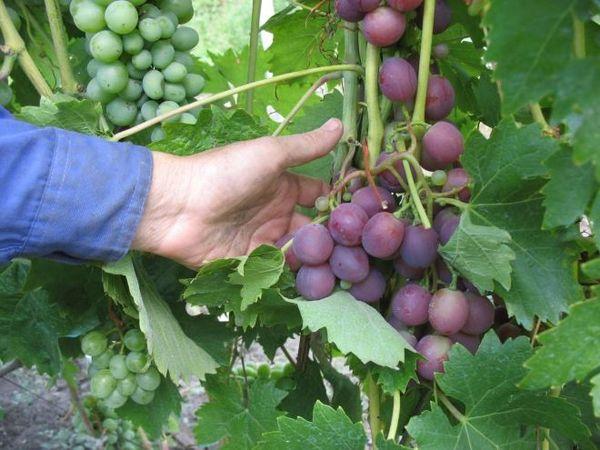
The grapes are large, weighing between 6 and 10 grams. They are oval in shape, purple-red in color, and have a sweet, muscat-like flavor. The fleshy fruits contain 2 to 4 seeds.
The bushes grow quickly, with vines reaching 3 meters in length. The flowers are bisexual, so pollinators are not required.
The vine ripens well, the adult leaves are large, green, medium-dissected.
Disease resistance
Cardinal grapes are susceptible to the main diseases of the plant: powdery mildew, mildew, and bacterial canker. These diseases can quickly spread throughout the entire vine. To prevent these diseases, the vines are sprayed with antifungal agents several times per season.
Frost resistance
Cardinal grapes do not tolerate temperatures below -20°C. Therefore, the bushes must be carefully covered for the winter, especially young seedlings up to 3-4 years old.
Productivity
A single vine yields 20-25 kilograms of ripe berries. Yields can vary depending on weather conditions. Grapes tolerate mild drought better than excessive moisture.
Transportability
The berries have thick skins, so they withstand long-distance transportation well. To ensure long-term preservation, the bunches are transported in boxes no higher than 20 centimeters. Due to their excellent transportability, Cardinal grapes can be sold throughout the country.
Advantages and disadvantages
The positive qualities of the variety include:
- early ripening;
- long shelf life of berries;
- pleasant taste;
- good transportability;
- high yield;
- drought resistance.
Negative characteristics include weak resistance to diseases and frost, as well as uneven ripening of fruits in clusters.
How to plant
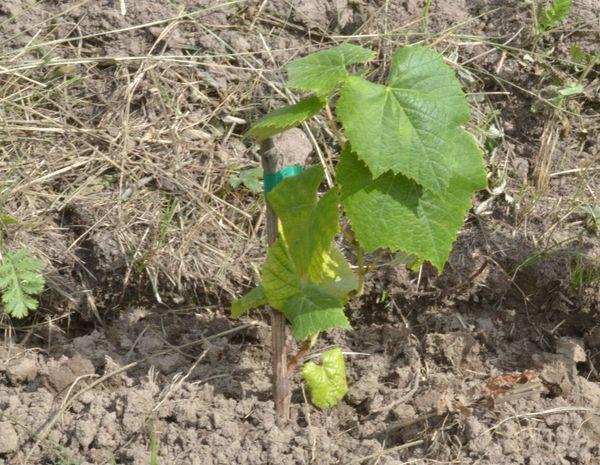
Planting material should be purchased in the same region where it will be planted. Otherwise, the seedlings will need more time to adapt.
Recommendations for choosing deadlines
Grapes are planted after the threat of spring frosts has passed. In warmer regions, this may be as early as late March. A vine planted in the spring will have time to gain strength before the frost sets in.
Grapevines can also be planted in the fall, but there are some risks. The seedlings must have time to establish themselves before the first frost, which can arrive earlier than usual. Plants planted in the fall must be insulated.
Site selection and preparation
Grapes thrive in warm conditions, so choose a sunny planting site. Groundwater levels should be low, otherwise the root system will become waterlogged. Grapes prefer fertile soil but will thrive in sandy loam or loamy soil.
If the soil is acidic, add dolomite flour or chalk. Two to three weeks before planting, dig a hole 60 centimeters deep.
If the soil is sandy loam, drainage is not required; if it is loamy, a layer of expanded clay or small stones is placed at the bottom of the hole.
How to select and prepare planting material
Seedlings should be purchased immediately before planting. The trunk should be healthy, undamaged, and the buds firmly attached. To check the viability of the roots, they are cut and inspected: healthy roots are white and moist when cut. A day before planting, the root system is immersed in a bucket of room-temperature water.
Planting diagram
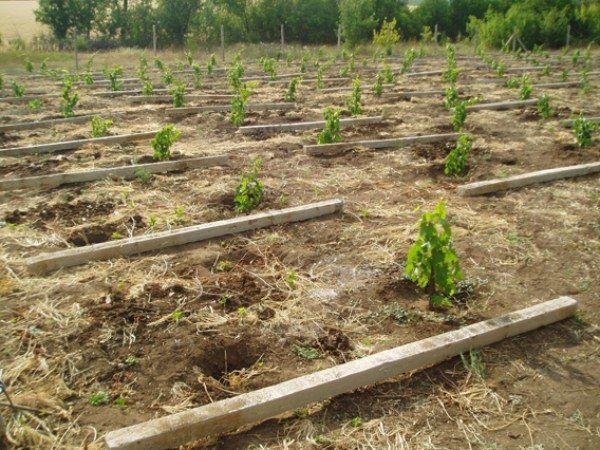
A trench for the grapes is dug 60 x 60 x 60 centimeters. Planting is carried out as follows:
- the hole is filled ⅔ full with prepared substrate;
- place the seedling, straighten the roots, add a little soil;
- pour in 2 buckets of water;
- add the remaining soil and compact it lightly.
The tree trunk circle is mulched with compost and straw.
Care instructions
The seedlings require moderate watering, fertilizing, and treatment several times per season, as well as mulching around the trunk. In spring and fall, the bushes are pruned and covered in anticipation of the harsh winter.
Watering
Seedlings are watered generously upon planting to ensure they take root well. Subsequently, irrigation is adjusted as excess moisture can lead to root rot and cracking of the berries. The bushes require watering during the formation of ovaries and buds.
Top dressing
Grapes grow in the same spot for a long time, sucking nutrients from the soil. Therefore, the bushes need to be fertilized several times a season. In early spring, granular superphosphate is scattered around the plants.
In May, to increase the growth of green mass, the grapes are fed with nitrogen. Ammonium nitrate or urea are used for this purpose. At the beginning of budding, the vines are fertilized with a complex mineral composition, predominantly potassium and phosphorus. The last time of the season, after harvest, the grapes are fed with potassium.
Important! Before applying fertilizer, water the tree trunk area generously to prevent salt burns to the roots.
Mulching
When planting, bushes are mulched with compost, humus, and straw. Mulch helps retain moisture in the soil and also prevents rapid weed growth.
Formation
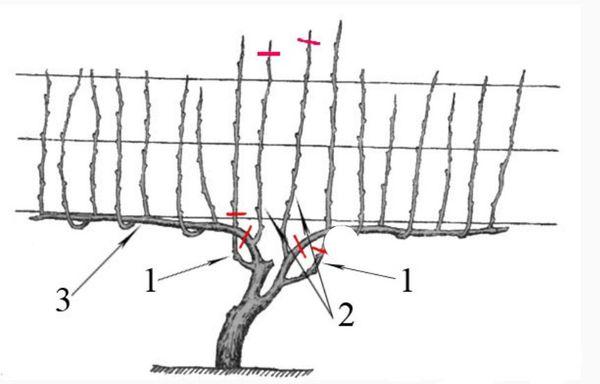
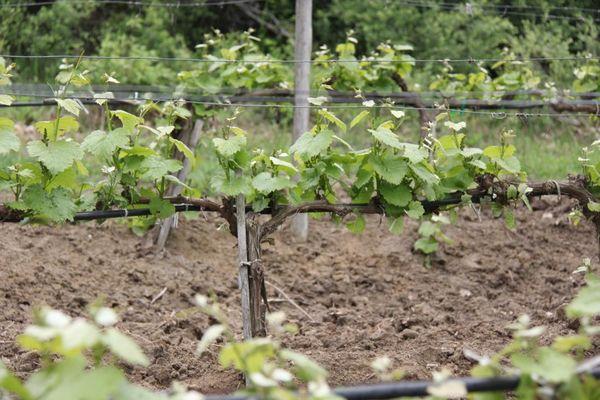
From the very first year after planting, grapevines need to be trained. Gardeners typically grow them as a single, low wall. Trained this way, the plant receives ample sunlight. Furthermore, the bush receives good wind circulation, which prevents diseases and pests.
Preventive treatment
The Cardinal grape variety has poor resistance to pathogenic microorganisms and harmful insects. For this reason, it requires several treatments with fungicides and insecticides throughout the season.
Installation of the support
Immediately after planting the grapevine, a support peg is installed next to it. The shoots, tied to it, will not break in the slightest gust of wind. Furthermore, the vine grower uses the staking to ensure the correct direction for the vines.
Shelter for the winter
If a harsh winter is expected, the bushes require shelter. To achieve this, the root zone is mulched with compost, humus, and straw before the onset of frost. The shoots are removed from their supports and covered with spruce branches and non-woven fabric.
Protection from wasps and birds
To protect against wasps and feathered pests, place scarecrows and hang rustling film near the Cardinal grapes. Additionally, each bunch can be covered with a special bag with small mesh. Smoke from a campfire will also repel grape pests.
Crop rationing
No more than two grape clusters are left on a single shoot. This will help the berries grow larger and fill with juice faster. Relieving the strain on the bush will help it cope with diseases more easily.
Sanitary pruning
In the fall, remove dried, broken, and diseased branches. In the spring, prune frost-damaged vines, as well as excess shoots that are crowding the bush. Leave three to six buds on the vine.
Grafting cuttings onto an adult rootstock
One effective method of propagating grapes is grafting onto mature rootstock. This procedure is performed in the morning or evening, or during the day on a cloudy day. Grafting can be done in various ways in spring, summer, or fall.
How to prepare cuttings
In the fall, woody cuttings (saplings) are taken from well-developed vines, measuring 5-8 millimeters in diameter. Each cutting should have at least 2-3 buds. Before storing, the cuttings are sprayed with a copper sulfate solution. Once dry, they are wrapped in plastic wrap and stored in a basement until spring.
Choosing a term
The best time to graft grapes is spring. For the procedure to be successful, the air temperature must reach 15°C. The optimal month for grafting is April.
Growth stimulator
To ensure successful grafting, the cuttings can be placed in a growth stimulant for 15-20 minutes. Epin or another growth enhancer can be used for this. The cuttings are sharpened and placed in the solution.
How to graft
The vaccination procedure is carried out as follows:
- the bush used as a rootstock is dug up to a depth of 15-20 centimeters;
- the vine is cleared of bark and the upper roots are cut off;
- a 3-4 cm deep split is made in the center of the rootstock;
- a prepared pointed cutting is inserted into the gap;
- The grafting site is wrapped with film and coated with clay.
Spring grafting of grapes This method is considered the most successful. Propagation can be done in the summer by grafting a green scion onto a green shoot. If shoots have not appeared on the scion within 2-3 weeks, the procedure should be repeated. To do this, cut off the top of the rootstock, make a new cleft, and insert the scion into it.
Please note! Immediately after grafting, the grape vine should be watered and hilled, and the soil around the trunk should be loosened to improve oxygenation.
Diseases and pests
The Cardinal variety has a weak immune system and is susceptible to major grape diseases.
Oidium
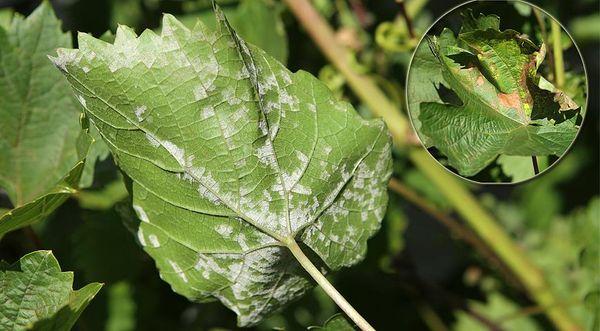
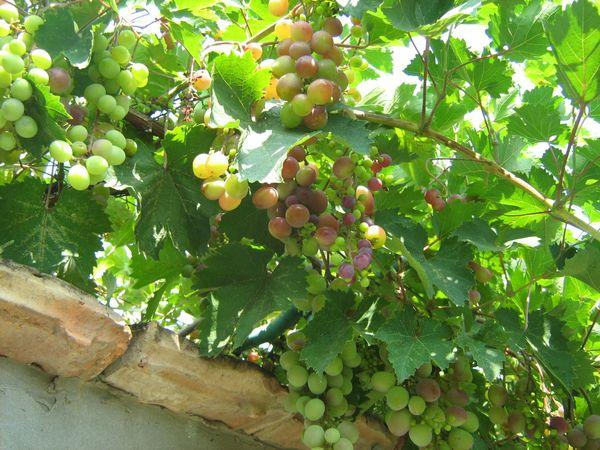
This disease is also called powdery mildew because the leaves appear to be dusted with flour. This is especially noticeable in June. To prevent the disease, the bushes and the surrounding area are sprayed with fungicides.
Mildew
The disease is caused by microscopic fungi that overwinter in plant debris. With the onset of warm weather, they quickly spread throughout the entire vine. It also occurs with excess nitrogen and a lack of potassium. As a preventative measure, grapes are sprayed with antifungal agents in spring and summer.
Harvesting and storage
The berries ripen unevenly, so the harvest is done gradually, as they ripen. The process is carried out in dry, sunny weather. Any cracked fruit is used first. Grapes intended for storage must be in perfect condition.
Applications of berries
Cardinal is a table grape variety, primarily eaten fresh. It is also grown commercially, as its early ripening grapes are in high demand. The berries can also be used to make compote, juice, and wine.

Tips and advice from experienced gardeners
Winegrowers offer the following tips and recommendations for growing Cardinal grapes:
- Choose a well-lit location for the seedlings, otherwise the berries may be less sweet than stated in the characteristics.
- Water the bushes moderately: they will tolerate drought better than excessive moisture.
- Trim off excess shoots and bunches.
- To prevent the appearance of diseases and pests, remove plant debris from the tree trunk circle and spray the bushes with insecticides and fungicides.
- In anticipation of a frosty and snowless winter, remove the vine from the support and cover it with mulch and non-woven material.
Cardinal is a capricious grape variety, but by studying information about its cultivation, a gardener can grow bushes with pink-purple aromatic berries on their plot.
Related posts:
 Description of 30 grape varieties for Siberia, planting and care for beginners
 Beginner's Guide to Growing Grapes in Open Ground in Central Russia
 Description of the Cardinal strawberry variety, planting and cultivation
 Description of 30 varieties and types of Muscat grapes, planting, cultivation and care
 How to grow grapes in the Moscow region in open ground without a greenhouse
 Description and pruning group of clematis Rouge Cardinal, cultivation and propagation
 Description of the Julian grape variety, planting and care instructions
 The ripening time of grape vines by variety, how to speed up the process, and what to treat the plant with