
- Pepin Apple Tree: Breeding History and Variety Characteristics
- Tree size and root system
- Leaves and flowers
- Productivity and annual growth
- Application of fruits
- Resistance to drought and frost
- Resistance to diseases and pests
- Varieties
- Cultural winter
- Creeping
- Pros and cons: is it worth planting?
- Landing features
- Recommended timeframes
- Suitable place and soil
- Step-by-step landing algorithm
- Apple tree care
- Irrigation
- Fertilization
- Sanitary and formative pruning
- We fight pests and diseases
- The nuances of harvesting and storing crops
The Saffron Pepin apple tree has been cultivated by gardeners for just over 100 years. However, it's no longer as popular as it once was. This is primarily due to the development of numerous hybrids with a more vibrant flavor and aroma. However, true Pepin connoisseurs continue to grow this ancient variety. Below is information on planting and caring for the apple tree.
Pepin Apple Tree: Breeding History and Variety Characteristics
The Saffron Pepin was developed by I.V. Michurin in 1907. It was obtained by crossing the Reinette d'Orléans with a hybrid obtained by crossing the Chinese apple and the Lithuanian Pepin. The Pepin is recognized as the most successful variety developed by the renowned scientist.
Additional information: New apple varieties are still being developed based on the saffron pepin.
Tree size and root system
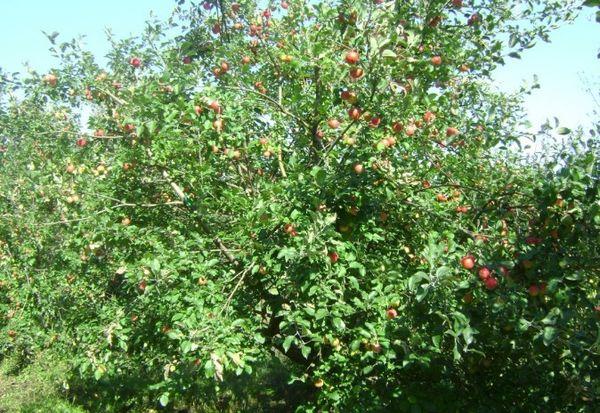
The Saffron Pepin apple tree is fairly compact, averaging about 3 meters in height. The trees have a spherical crown with branches drooping toward the ground. The Pepin apple tree's root system is fibrous.
Leaves and flowers
The pubescent leaf blades are emerald green. They are elliptical in shape, tapering toward the upper edge. Small, snow-white flowers bloom in June. Both male and female flowers are produced, so this apple variety requires no pollinators.
Productivity and annual growth
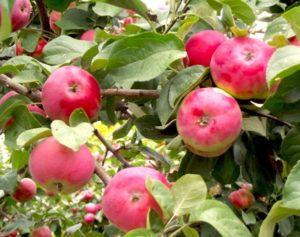
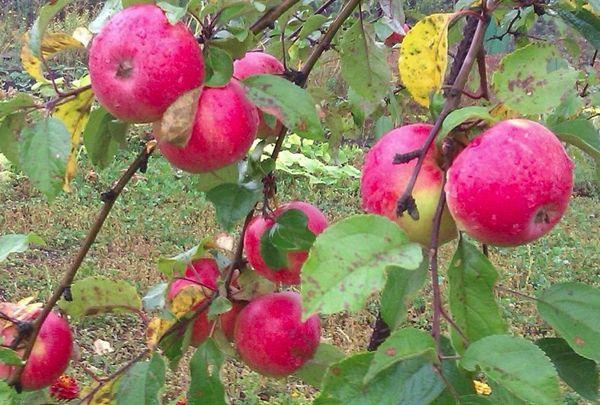
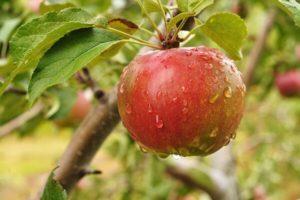
The fruit grows on one-year-old shoots that are 15 centimeters long. Fruiting begins in the fifth year after planting, and a full harvest is expected after seven years. With proper care, the tree produces approximately 250 kilograms of fruit. The apples are red when fully ripe.
Application of fruits
Saffron pepin is eaten fresh and also used to make juices, marmalades, and jams. The apples are suitable as a filling for baked goods and as a salad ingredient. The fruits can be transported over long distances while maintaining their flavor and appearance.
Resistance to drought and frost
The saffron apple tree has moderate frost resistance. For this reason, it is not cultivated in northern regions. In southern regions, the apple tree recovers quickly from frost. It does not tolerate drought well, so abundant watering is necessary, especially for young seedlings.
Resistance to diseases and pests
This variety is susceptible to various fungal diseases. To prevent them, the apple tree's crown should be thinned annually, the trunks whitewashed, and dead leaves removed. Affected plants should be sprayed with fungicides. The crop is also susceptible to codling moth infestation, which can be controlled by spraying the crown with chemicals.
Varieties
Breeders have developed several varieties of saffron pepin. The most well-known are: Autumn Joy, Cultural Winter, Creeping, Souvenir of Altai, and Friendship of Peoples.
Cultural winter
Apple trees are suitable for growing in central and central Russia. They do not tolerate highly acidic soil. For this reason, the soil must be limed before planting.
Creeping
This variety of apple tree has a flexible, elastic trunk. It requires more careful care to keep its branches horizontal. This type of apple tree is frost-resistant.
Pros and cons: is it worth planting?
The advantages of the Saffron Pepin apple tree include the following qualities:
- rapid recovery after frost;
- the ability to bear fruit without pollinators;
- apples hang on the tree for a long time without falling;
- good keeping quality and transportability of fruits: in good conditions they can be stored until April;
- excellent taste, and the longer they are stored, the tastier they become.
Disadvantages include:
- susceptibility to fungal diseases and pests;
- need for annual pruning;
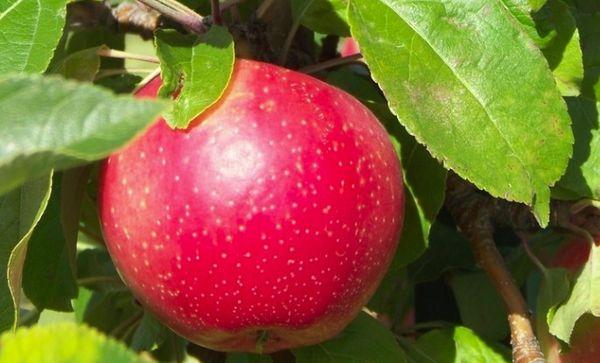
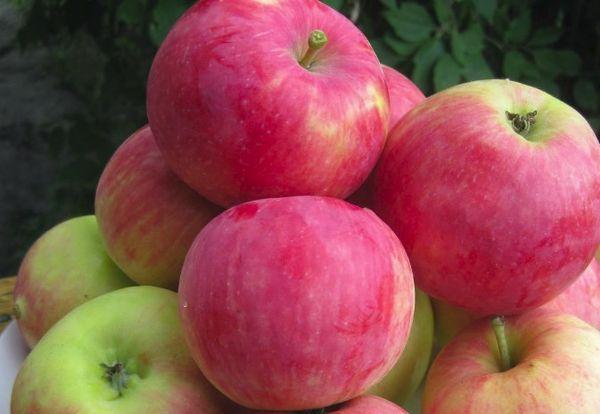
- small apples, weighing 90-120 grams;
- The fruits do not store well after falling due to strong gusts of wind.
By comparing the pros and cons, the gardener determines whether it is worth planting the saffron pepin on his plot.
Advice! To avoid disappointment, buy saffron pepin at a specialized store after reviewing the quality certificate.
Landing features
When planting, be sure not to bury the root collar too deeply. Otherwise, fruiting will be delayed for 2-3 years. It's best to prepare the hole 1.5-2 weeks before planting. Before planting, soak the seedling in a bucket of water for 3-4 hours to saturate it with moisture.
Recommended timeframes
Saffron pepin is planted in its permanent location in early spring or before mid-autumn. Spring planting allows the seedlings to establish roots well before frost sets in. After planting the apple tree in the fall, it must be carefully prepared for winter.
Suitable place and soil
Choose a sunny, wind-protected planting site. Groundwater levels should be no more than 2 meters above the ground surface. Apple trees will not thrive in acidic soil; nutrient-rich loams and sandy loams are ideal.
Step-by-step landing algorithm
Planting of seedlings is carried out as follows:
- a hole is dug with a width and depth of 80-90 centimeters;
- drainage made of expanded clay and broken bricks is placed on the bottom;
- a mixture of humus, river sand, peat with the addition of 1 tablespoon of nitroammophoska is sprinkled on top;
- The hole is watered, the roots are placed on the nutrient mixture, straightened out, and covered with soil.
The tree trunk circle is compacted, watered again, and mulched.
Apple tree care
When caring for the saffron pepin, keep in mind that it requires regular watering, fertilizing, and pruning. Diseases and pests, which must be controlled throughout the season, can reduce yields and even kill the trees.
Irrigation
The younger the plant, the more frequently it needs to be watered. The soil around the trunk should not dry out. After watering, carefully loosen the soil. For adults Apple trees especially need watering in July and August. Trees are generously watered in late autumn, before frost: the moisture in the soil will soften the negative impact of frost.
Fertilization
Without fertilizer, the fruits will be small and the yield will be poor. In addition to applying nutrients to the soil, foliar feeding can be used. A 0.5% urea solution is used for this purpose in early spring.
After the apple tree has blossomed, the root system is nourished with a solution of bird droppings, diluted in the following proportions:
- 1 part of litter;
- 15 parts water.
In summer, phosphorus-potassium fertilizers are used to improve vegetation processes.
Sanitary and formative pruning
In spring, dry and broken shoots are pruned from the saffron pepin. These not only diminish the plant's decorative appearance but also serve as sources of disease. In addition to sanitary pruning, formative pruning is performed, which involves removing branches growing inward.
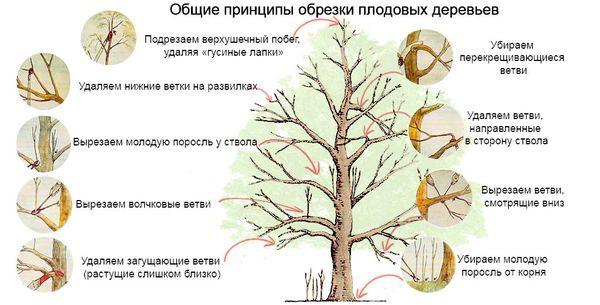 Please note! No more than a third of the shoots should be pruned, otherwise the plant will have a hard time recovering from the procedure and may not produce a harvest this year.
We fight pests and diseases
Prevention is better than cure. To achieve this, dense plantings are thinned out, trunks are whitewashed with lime and copper sulfate in the fall, and dry leaves are removed from the tree trunks. In the spring, before bud break, trees are sprayed with a 3% Bordeaux mixture solution.
The nuances of harvesting and storing crops
Harvesting should be done carefully, preventing the fruit from falling to the ground. Damaged apple trees do not store well. The basement temperature should be maintained between 0 and 2°C. To ensure proper storage, the fruit is layered with paper or wood shavings in boxes.
Related posts:
 Description and varieties of the Sinap apple tree, planting and care rules
 Signs and treatment of apple tree cancer, varieties resistant to the disease
 Description of the Chudnoe apple variety, planting and caring for a dwarf tree
 Description and characteristics of the columnar apple tree President, planting and care
 Description and planting of the Dream apple tree variety, care and propagation
 Description and technology of growing the Vishnevoe apple tree variety
 Description and rules for growing creeping apple trees, planting and care
 Description and characteristics of the Spartan apple variety, cultivation tips