
- Peculiarities of onion harvesting in the northwest
- In the Arkhangelsk region
- In the Leningrad region
- In the Kaliningrad region
- In the Novgorod region
- Onion harvesting times depending on the region
- How to determine the ripeness of root vegetables?
- Preparatory work
- How to speed up the ripening process of crops?
- Stop watering
- Undermining the roots
- Exposing the bulbs
- Harvesting
- Assembly considerations in rainy weather
- How to prepare onions for storage?
- Storage conditions
Every vegetable has its own planting and harvesting time. The same applies to onions. Timely harvesting will ensure their best preservation over the winter. It's also important to consider the weather conditions of different regions. Below, we'll discuss when to harvest onions in the northwest.
Peculiarities of onion harvesting in the northwest
This region includes the following oblasts: Kaliningrad, Leningrad, Pskov, Novgorod, Arkhangelsk, and the Komi Republic. Summers here are generally cool and rainy, with hot days rare. Temperatures typically range from 18 to 20˚C. When harvesting, it's important to keep in mind that each oblast is quite vast. Consequently, temperature and precipitation will vary across the region.
In the Arkhangelsk region
Vegetables ripen slowly here. Therefore, the harvesting time for any crop, including onions, is highly individual.
In the Leningrad region
The most favorable period is from late July to the second half of August. During this time, the weather remains warm, but rainfall gradually increases. It's best to dig up onions in dry weather. Therefore, experienced gardeners look for clear, dry days to reduce the time spent drying them. The heaviest rainfall begins in mid-August.
In the Kaliningrad region
Late August is the ideal time. This is when the rainfall ends, and nature seems to freeze in anticipation of autumn. Warm days during this period allow for harvesting.
In the Novgorod region
August brings heavy, cold rains. However, these are then followed by what is known as golden autumn. Precipitation levels drop significantly.
Onion harvesting times depending on the region
Onion harvesting times in the northwestern regions also depend on planting time. When growing onions, people often encounter the following problem: in July, when the bulbs are actively developing, relatively warm days can be followed by a sharp cold snap with rain. Under these conditions, the onions begin to regrow. Preserving such onions for the winter will be extremely difficult. It's best to focus not on specific dates, but to constantly monitor the weather to avoid missing favorable days.
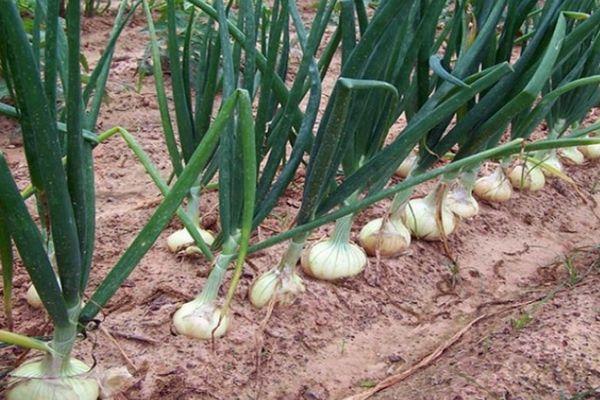
It's also important to consider the increasing contrast between day and night temperatures. Don't delay harvesting onions; this will ensure a much better harvest.
Tip! You can use a lunar calendar. In this case, onion harvesting time will depend not on weather conditions, but on the phases of the moon. It is also believed that vegetables should be harvested during a full moon. This will preserve the most nutrients.
How to determine the ripeness of root vegetables?
Not all onion varieties are suitable for growing in the northwestern region. To ensure a good harvest of this vegetable, locals use the following varieties: Black Prince, Timiryazevsky, Moldavsky, Buran, Arzamassky, Boterus, Myachkovsky 300, and Red Baron.
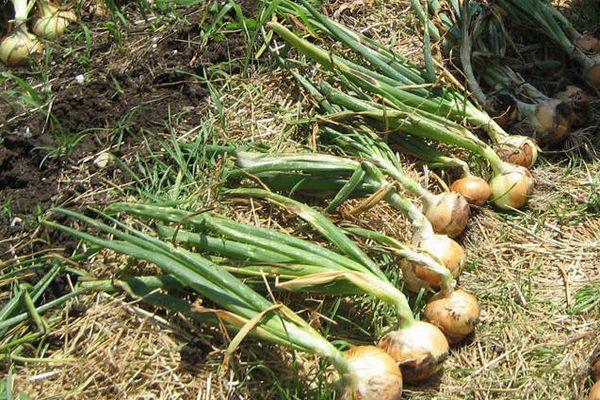
The following signs indicate that vegetables are ripe:
- dry, yellowed feathers;
- most of the onion feathers fell to the ground (about 60-80%);
- onion scales are colored with appropriate pigments (depending on the variety, the color will be dark brown, purple, bronze or white);
- the neck of the bulb dries out and becomes noticeably thinner.
Important! Many gardeners determine harvest time the old-fashioned way. They simply count 70 or 80 days from planting.
Preparatory work
It's recommended to begin harvesting in the morning, but there shouldn't be any dew. Avoid pulling out the bulbs. It's better to dig up the soil with a pitchfork or shovel. This will ensure less damage to the fruit, which means a longer shelf life.
If the deadline is missed, the onions will have a weak taste and smell, the roots will begin to grow again in the soil, immunity to diseases and pests will decrease sharply, the outer scales will peel off (and, as we know, onions do not last long without them), and the harvest may be partially lost.
How to speed up the ripening process of crops?
Onions take a long time to fully ripen. This is detrimental to areas where cold rains arrive early. The harvested roots will then require a long time to dry, and they may even rot. To avoid this, people have learned to speed up the ripening process.
Stop watering
This can be done 2-3 weeks before the expected harvest date. By this time, all the bulbs will be fully formed. Dry weather shouldn't be a problem. Regular moisture in the soil stimulates growth and shortens the storage period. If it rains during this period, it's best to cover the onion beds with waterproof film or thick cloth.
Undermining the roots
This is done to reduce the amount of moisture and nutrients the plant receives from the soil. Carefully, to avoid damaging the fruit, lift it out of the ground with a pitchfork (or garden fork).
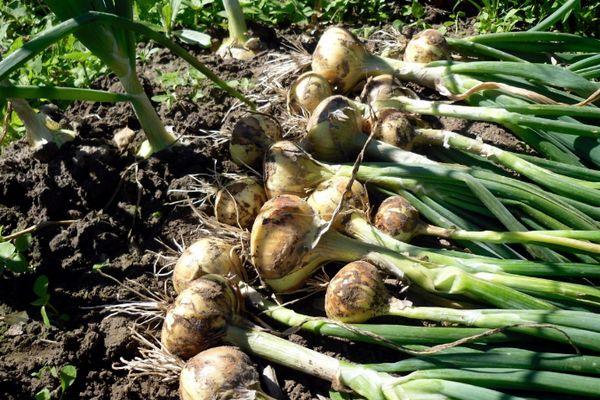
You can also remove the bulb halfway from the soil and leave it there for about 5 days. However, this method is only suitable if the onion is growing in soft soil and the weather is dry.
Exposing the bulbs
Use a small shovel and carefully remove the top layer of soil. You can also do this by hand. This will allow the onions to naturally ventilate and dry out while still in the garden bed. This is assuming there's no rain, of course. This method is suitable for root vegetables planted deep in the ground.
Harvesting
The entire process should take no more than 10 days. You can remove the bulbs from loose soil by hand, pulling them out by the dry stems. If the soil is heavy, you'll need to use a pitchfork or shovel. A pitchfork is a gentle tool that won't damage the bulbs. However, digging with a shovel requires care. Drive the spade into the ground at least 10 centimeters from the row. Simply dig up the bulbs and then release them from the soil by hand.
The outer scales should remain intact, free of cuts, scratches, and dents. Never smash the fruits against each other or against a shovel. The slightest damage will cause the vegetable to rot. The tops should also be avoided. Bulbs with broken or trimmed tops should be discarded for eating; they are not suitable for storage.
Assembly considerations in rainy weather
In this case, it's best to choose the driest day. Onions dug from wet soil take longer to dry. They need to be washed, topped, and the outer scales removed. Choose a room with good air flow for drying. A draft is even recommended. The entire process will take approximately 20 days. This will allow time for new scales to grow. An extreme method is a hot oven. Eight days at a maximum temperature of 44˚C (113˚F) and five at 33˚C (93˚F). However, this type of vegetable doesn't store as well.
How to prepare onions for storage?
If the weather is sunny, it is best dry onions Directly in the garden bed. At night, the fruits are hidden under a canopy. If left on the ground overnight, they should be covered with a thick film to protect them from dew. The drying process takes approximately 1-2 weeks. The tops are not cut off.
Important! In damp weather, onions should be dried in a well-ventilated area. This could be an attic or a shed. The onions should be laid out in a single, even layer on wooden trays or mesh. To ensure even drying, rotate them periodically.
The optimal temperature is 25-30˚C. The roots ripen fully, and the neck closes well, increasing resistance to pests and diseases and extending shelf life.
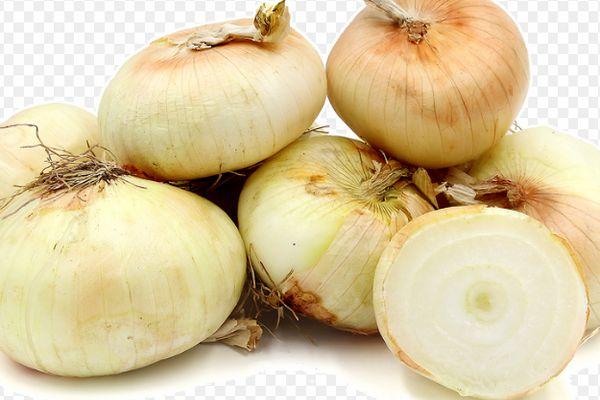
Once the onions have dried out a bit, you can begin pruning. It's not recommended to do this any earlier, as freshly cut onions can harbor microorganisms that can cause various diseases. Pruning is essential, otherwise the bulbs won't dry completely.
Feather removal guidelines:
- there is no need to cut off the neck completely;
- The feathers should be removed only if the onions are not going to be stored braided;
- You shouldn't cut the roots all the way off (you should leave at least half a centimeter to a centimeter).
Tip! Form a mound of onions and stick your hand into it. If this process is easy, the onion is ready to be stored for the winter.
Storage conditions
The storage area should be dry: a pantry, mezzanine, cellar, kitchen, or a glassed-in balcony. Before final storage, the harvest should be carefully sorted. Keep in mind that peeled, sprouted, soft, or moldy onions will not last long. Furthermore, they can cause even good onions to spoil. Cut onions should be consumed within 5 days. It is not recommended to store onions in bulk. It is better to lay them out in layers of 20 or 30 centimeters.
The container must be made of breathable materials:
- Compact wicker baskets. They allow air to pass through on all sides, so there's no risk of rot. The downsides include their small size and the fact that they can't be stacked.
- Boxes made from wooden planks. These containers will keep the bulbs dry. They're perfect for small basements and pantries. They stack easily.
- Cardboard fruit boxes. They come pre-drilled with special round holes for ventilation. If necessary, you can make your own (in the sides and bottom). The onion layer should be no more than 20-30 centimeters thick. Chalk will provide additional protection against disease. Sprinkle it around the onions (200 grams of chalk per 10 kilograms).
Some more storage tips:
- Leeks don't need to be completely dried. Simply trim off the tops and place them in boxes filled with sand. A basement is the best place.
- For onions that are set aside for eating, the temperature should be maintained within the range of + 20-22 ˚C.
- It's a different story with small onion sets. They require cool temperatures (no higher than 5˚C). They dry out quickly in warmer temperatures. It's also a good idea to choose a suitable location for them in advance so you don't have to move the container later.
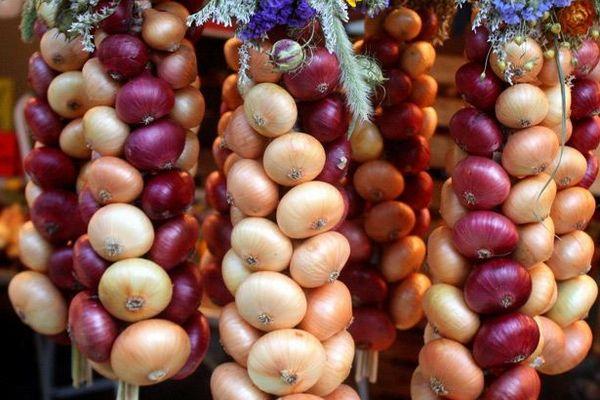
- Comfortable storing onion crops, hanging it on a regular nail. Disused nylon stockings or tights can be used for this purpose. Braided shallot heads look more aesthetically pleasing. When pruning, leave the tips at least 10-15 cm long. Take a thin rope, loop it around the neck of the bulb, and imitate the braid. Make a loop for the nail. Keep the shallot heads out of direct sunlight. This is a good way to store shallots, but it works for other varieties as well.
- During the winter, onions need to be sorted at least 3 times.
Residents of regions with harsh climates farm differently than those in temperate climates. In such areas, harvesting vegetables is much more difficult. Therefore, harvest times for specific crops are determined based on years of observation of the vagaries of nature.
Related posts:
 When to harvest leeks from the garden for storage, ripening times
 50 types and varieties of perennial onions with descriptions, cultivation, and care
 How and when to plant onions to get large bulbs
 Description of the best varieties of onions, planting and care in open ground
 The beneficial properties of white onions, description of varieties, cultivation and care
 Description of varieties and cultivars of wild onions, the subtleties of cultivation
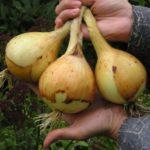 Description of the Exhibition onion variety, growing from seedlings, planting and care
 When to harvest onions planted in autumn and spring from the garden for storage, how to determine the timing