
- How to determine the ripeness of onions
- External signs of maturity
- Mathematical method
- When to harvest onions from the garden
- Lunar calendar
- Country life hack
- How to properly dig up onions from the garden beds
- Onion
- Leek
- Onion sets
- Shallots
- How to speed up the ripening process of crops
- Stop watering
- Undermining the roots
- Exposing the bulbs
- How to prepare onions for storage
The lunar calendar determines the precise timeframes for harvesting onions in 2025. The calculations take into account the phases of the moon, which are most beneficial for gardening. Detailed recommendations will help you grow and harvest a crop that will store well without losing all its nutritional value. When harvesting, it's important to consider not only the calendar date but also weather conditions. There are also external indicators of ripeness.
How to determine the ripeness of onions
There are three main ways to determine the full maturity of onions:
- You can recognize the ripeness of a vegetable by its external signs, examining the condition of the tops and bulbs.
- The mathematical method will help when the variety and its ripening time are known precisely.
- The lunar calendar will tell you the exact date for any work in the garden.
In any of these cases, weather plays a decisive role. If cold and rainy days occur, harvesting can be significantly delayed.
External signs of maturity
You can tell that an onion is ripe by the following external signs:
- the tops begin to turn yellow, dry out and fall onto the garden bed;
- new feathers do not appear;
- the neck of the onion becomes thinner and dries out;
- The top scales of the onion are easily removed and rustle.
The ripe bulb is juicy in taste, with well-formed plates that emit a pleasant, characteristic aroma.
Mathematical method
To determine the exact date of harvesting, you can use the date obtained by a simple mathematical calculation.
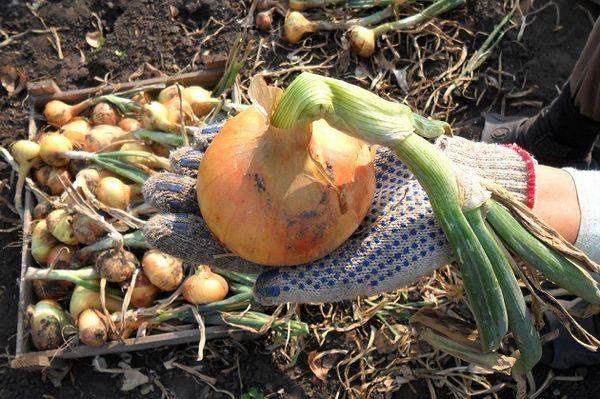
The general onion ripening period ranges from 68 to 82 days. This varies greatly depending on the variety chosen. Early varieties require less time to develop fruit than late varieties.
Understand, When to harvest onions from the garden for storageIt's quite simple; just solve a simple problem. Add the number of days needed for the variety to the planting date of the vegetable crop. The resulting sum is considered the best time to harvest the onions.
If the days are hot and dry, harvesting is done earlier, taking into account the condition of the vegetable beds. In a rainy, cool summer, root crops ripen later, and the result of the mathematical equation will be of no use.
When to harvest onions from the garden
Once all the main signs of onion ripening have been noticed, choose a sunny, dry day. The weather forecast suggests no rain in the coming days. This will allow the harvested crop to dry in the sun.
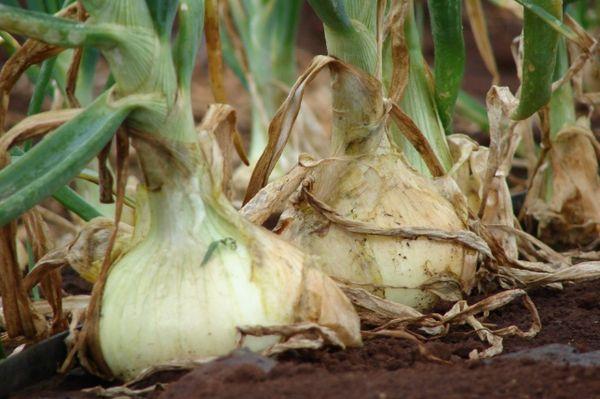
According to the lunar calendar, onion harvesting begins in the second half of July and continues until mid-August. If the summer is rainy, choose a dry day. The harvested crop is stored in a well-ventilated area for further work.
Lunar calendar
Experienced gardeners have noticed that onions are stored best, harvested during the waning moon. According to the 2025 lunar calendar, the following are considered favorable days:
- in July it is better to harvest on the 1st-3rd, 6th, 28th-29th;
- in August the dates 1-7, 10, 26, 29-31 are suitable for work;
- Late varieties of onions can be harvested in September, the best days are the 1st-4th, 7th-8th and 26th.
Harvesting this spicy vegetable is also possible during the new moon. At this time, the plant focuses all its energy on developing its underground parts. The bulbs are filled with vitamins and juice. During the new moon, weeding and pest control are not recommended.
Country life hack
Advice from experienced gardeners can also be useful during the harvesting stage. When harvesting onions, many recommend following the dates indicated in the lunar calendar, as the phases of the moon largely determine the growth rate and quality of development of all plants:
- During the waxing moon phase, the plant rapidly gains strength and begins to grow. Biological processes are active in the upper part. All the sap from the lower part of the plant rushes upward. Watering is beneficial during this time. Onions should not be harvested.
- During the waning moon, the sap flows to the underground parts of the plant. During the waning moon, it's best to harvest and fertilize. Root vegetables will be tasty and nutritious.
During the new moon, it is permitted to weed the soil, loosen the soil, and moderately water vegetable beds.
How to properly dig up onions from the garden beds
Once the onion harvest date has been determined, preparations begin. Three weeks before the planned date, watering and fertilizing are stopped. Watering encourages new root growth and prevents root rot.
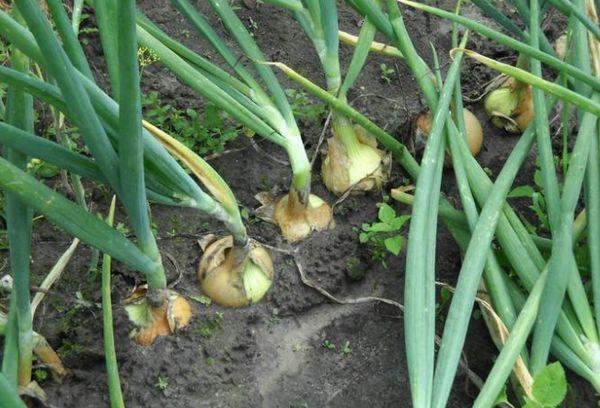
The cleaning process itself must be carried out in accordance with certain rules:
- the day should be sunny and dry (it is advisable to study the weather forecast and choose a time when no rain is expected for 12 days);
- If the soil is soft, you can pull out the bulbs by hand, but it is best to use a pitchfork or a shovel;
- Using a pitchfork, carefully dig up the area around the head, and then pull it out with your hands;
- You need to shake off any stuck dirt from the bulbs (do this carefully so as not to cause damage);
- You need to leave the onion to dry together with the tops (during the drying process, the tops will saturate the onion with nutrients);
- The dug-up crop is distributed in one layer on a flat surface and periodically turned over.
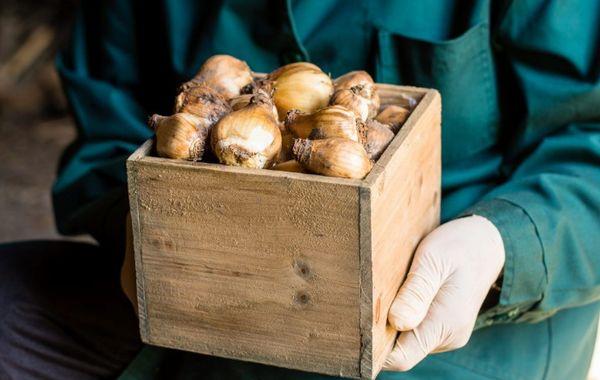
If you follow all the recommendations, root vegetables will be stored for a long time, preserving all their benefits, aroma, and taste.
Onion
Determining the best time to harvest ripe onions is easy. Most of the tops in the garden will turn yellow and lie flat. The best time to harvest ripe onions in August 2025 will be after the 8th.
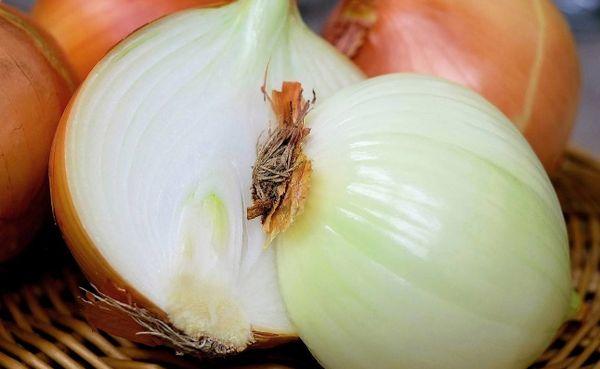
The plant's ripening period can be calculated using simple arithmetic. Add 68-76 days to the planting date. The resulting calculation determines the best day for harvesting.
Leek
The shelf life of leeks depends on the variety chosen. Early leeks mature in 100 days; they are not suitable for winter storage and are eaten immediately after harvest. Late leeks require 190 days to mature and can be stored for 6-7 months.
Onions for winter storage are dug up in mid-October, before the first frost. If they are to be used in the fall, they can be dug up as early as the end of August. Harvesting onions in rainy summer conditions should start earlier to avoid rotting.
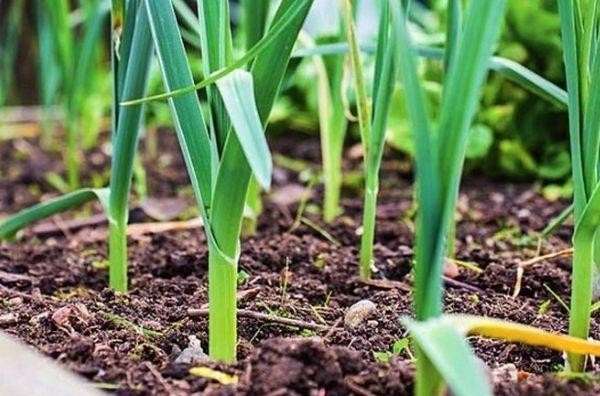
To harvest leeks, choose a moderately windy, dry day. Use a pitchfork to dig up the false bulb and shake off any dirt. It's best to store the well-dried stems in sand.
Onion sets
Onion sets are considered essential planting material, as the future harvest depends on their quality. Onion sets are harvested after planting nigella seeds. It's important to time the harvesting of the bulbs and follow the harvesting guidelines.
Digging begins in the first half of August. By this time, the bulb tops and necks will begin to dry out and turn yellow, and the scales will peel off easily, shiny, and rustling. Don't wait until all the yellowed tops have fallen, otherwise new roots will sprout. This will reduce the shelf life of the planting material, and the likelihood of bolting in the new crop increases.
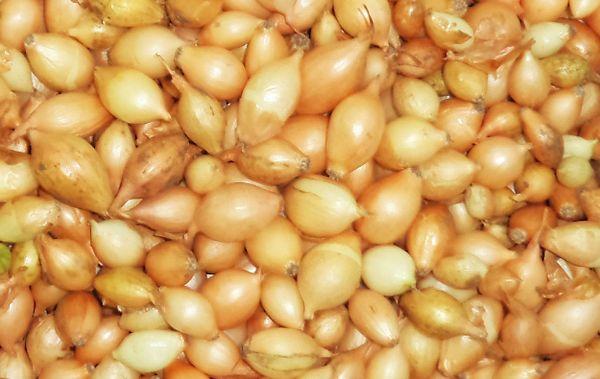
Dig the onion sets in dry weather with a pitchfork, leaving the harvest to dry overnight. Remove any dirt from the surface by hand; avoid smashing the bulbs together. If the weather is rainy and cold, dig the onions out of the ground earlier. This will help reduce the risk of disease and rot.
Shallots
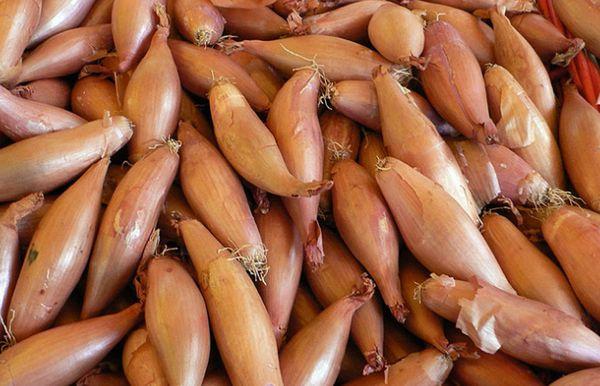
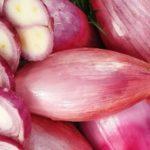
Shallot harvesting begins after the leaves have dried, which coincides with mid-August. Based on the lunar calendar, it's best to harvest onions during the full moon. Harvested during this time has a long shelf life and contains many nutrients.
Stop watering 15 days before harvest. Choose a sunny, dry day for harvesting. Dig up the shallots with a pitchfork, leaving the stems behind. Allow them to dry for two weeks. Then trim off the dry ends, and braid or gather the green parts into a bunch.
How to speed up the ripening process of crops
Experienced gardeners don't rely entirely on external signs of bulb ripeness. Sometimes, the bulb may be ready for harvesting, but the tips are still straight and green. To avoid harvesting during a rainy season, it's necessary to carry out a procedure that will speed up ripening:
- Root pulling helps. The bulb is gently pulled out of the ground. This must be done carefully to avoid damaging the entire root system.
- Stop watering 20 days before the expected harvest. This will allow all the nutrients to accumulate in the bulb.
- The last time fertilizer should be applied is 4 weeks before harvesting.
- Exposing the head by pushing back the soil allows oxygen, light and heat to better penetrate to the underground part of the plant.
Don't trim the plumes to speed up ripening. This will only lead to crop rot.
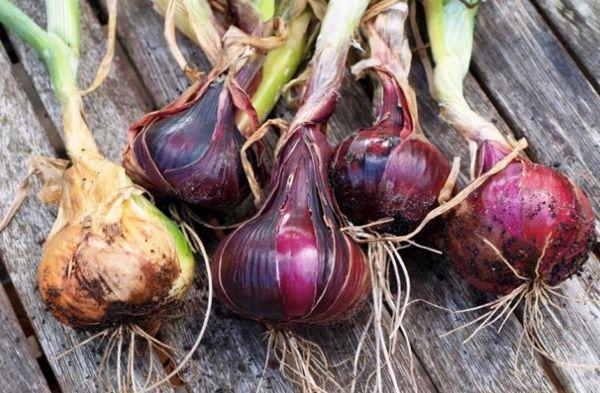
Stop watering
Dry soil promotes better ripening of the bulbs:
- To prevent the bulbs from spoiling and to ensure they are stored well for a long time, watering is reduced during the period of their formation.
- Onion harvesting should be carried out before the period of prolonged rains.
- As soon as the process of feathers drying out and turning yellow begins, watering is stopped completely.
- If it rains at this time, you can cover the beds with film.
As a result, onions stop being watered a month before harvesting.
Undermining the roots
To harvest a ripe onion crop, many gardeners perform root pruning. This reduces the plant's absorption of water and nutrients from the soil.
The bulb is carefully pulled out of the ground (you can dig it up with a pitchfork), slightly undermining the roots. This procedure is carried out carefully so as not to damage the bulb.
Exposing the bulbs
Stripping the bulbs is especially helpful for those who planted the vegetable too deeply. Using a spatula or hand, gently push back the top layer of the bulb.
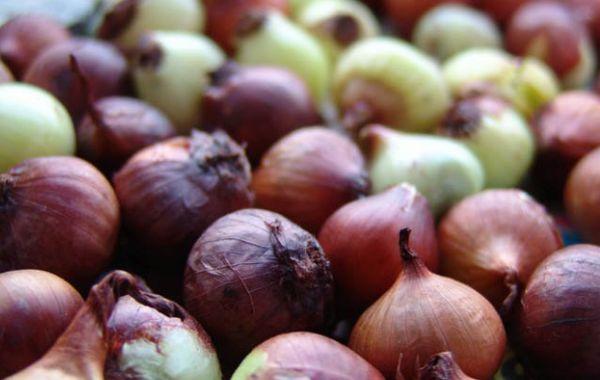
This procedure promotes better ventilation and warming of the plant's underground portion. As a result, ripening occurs earlier.
Some gardeners trim the bulb's roots by 5-6 cm, leaving the tops intact. The green tops nourish the bulb throughout the drying period and accelerate its ripening.
How to prepare onions for storage
After the entire harvest has been dug up, it is left to dry and disinfect in the sun. Dirt is shaken off the bulbs, and the tops are left intact. At night, the harvest is covered with plastic or stored indoors to prevent dew or rain from soaking the vegetables.
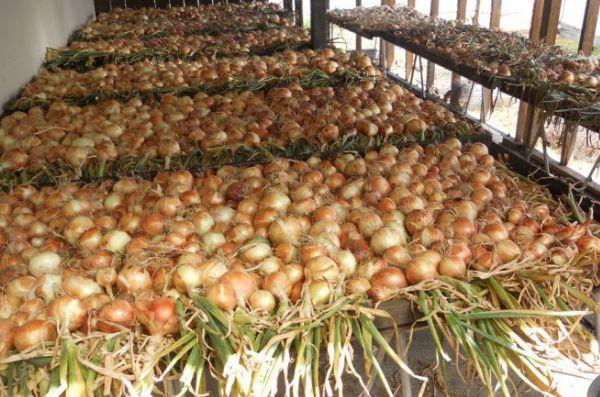
If the weather is dry and windy, the harvest is left in the garden bed after harvesting. In the garden, the harvest will dry completely within 12-14 days. After that, they begin trimming off the dried tops, leaving about 5.5 cm of the top. Some housewives store onions in braids or bunches, in which case only the tips of the tops are trimmed.
Large, firm, undamaged bulbs are selected for storage. The harvested bulbs are placed in cardboard boxes, wicker baskets, or cloth bags.
Related posts:
 When to harvest leeks from the garden for storage, ripening times
 50 types and varieties of perennial onions with descriptions, cultivation, and care
 Description of the best varieties of onions, planting and care in open ground
 How and when to plant onions to get large bulbs
 Description of the Exhibition onion variety, growing from seedlings, planting and care
 The beneficial properties of white onions, description of varieties, cultivation and care
 Description of shallot varieties, cultivation and care, when to harvest
 When to harvest onions planted in autumn and spring from the garden for storage, how to determine the timing