
Grow onions Growing onions is a challenging task that requires skill and knowledge of the crop's characteristics, as well as the correct variety for the climate zone. There are several ways to properly plant and grow onions.
Features of culture
The key to successful onion cultivation lies in the correct variety and quality of planting material, the correct growing location, planting time, suitability to climate conditions, and proper care. It's important to remember that early onion varieties can be grown from seed in one season, forming a large bulb, but without the appearance of a seed stalk.
Mid-season and late-season varieties go through a stage of 2-3 years:
- Nigella (onion seeds collected from arrows) is sown.
- In the middle of the season, after 100-110 days, black cumin grows into small bulbs, the so-called “sevka”.
- In the second year, the sets are planted and large bulbs (turnips) are obtained.
- In the third year, if the large bulb is not removed or planted in the spring, it will begin to produce shoots, on which ripe seeds (nigella) will appear from the flowers at the end of the season.
In the southern regions, a 2-year method is used: nigella seeds are sown in early spring (March, early April), and by mid-June the sets are planted and grown into large bulbs.
In the fall, some of the large bulbs are dug up for storage and consumption, while the other half are left in the ground and by the middle of the next season, the nigella is harvested.
Onions are an unpretentious plant, but you should follow the rules of agricultural technology:
- The location should be sunny; onions grow poorly in the shade.
- Distance from storage water tanks and deep groundwater levels.
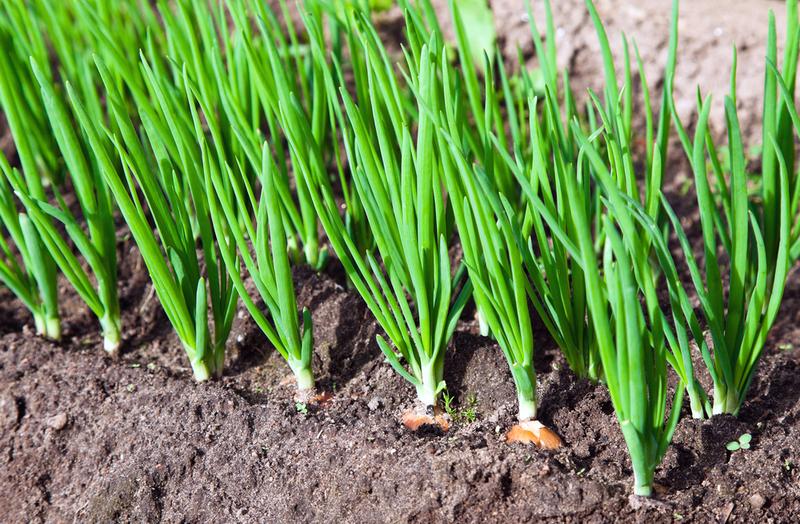
The variety should be chosen that is adapted to local conditions. It is very important to plant onions after the soil has warmed to 8-10 °C. For successful growing onions It requires long days. It tolerates short-term ground frosts, but they are still undesirable, as they stunt growth. During the growth phase, abundant watering and cool weather are essential, while during bulb formation, less watering and warmer temperatures are needed.
When choosing onion sets, it's important to consider the photoperiod of the onion variety. In southern regions, daylight hours range from 13-15 hours from early spring to late summer, while in northern regions, it ranges from 15-18 hours. Therefore, varieties from one region, planted in another, will quickly form bulbs and ripen under long daylight hours, while those from another region will produce large green shoots but not develop bulbs.
It is imperative to follow the condition for growing onions for bulbs: to form large bulbs from sets, do not trim the plant leaves during the season.
The planting material (sets) should be larger than 1 cm, unsprouted, free of mechanical damage or disease, with the husks intact, and free of rot. Good planting material should be firm, with a tightly attached and shiny husk and a dry stem.
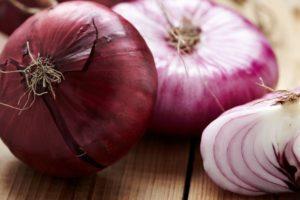
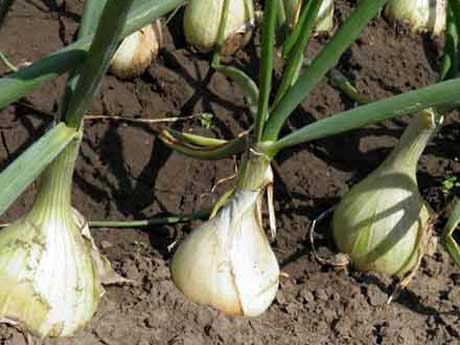
Soil preparation
For a bountiful and large harvest of onion sets grown outdoors, fertile soil is essential, and fertilizing is crucial. This requirement stems from the onion's structure and cultivation. Its root system is very fragile and grows in the topsoil, so proper soil preparation is essential for planting onions.
In the fall, add rotted manure to the plot and sow winter green manure to enrich the topsoil. Once the green manure has sprouted to a depth of 10-15 cm, mow it down and dig it in in the spring. Peat, sawdust, and wood ash can also be added to improve the soil composition; these will rot over the winter and make the soil loose. The best green manure to use before planting onions is vetch or mouse pea.
If the soil is dense and clayey, spread sand over the area before digging in the fall or spring. This will improve air permeability and loosen the soil. In the spring, prepare the beds, beginning with thoroughly loosening the soil and spreading fertilizers such as superphosphate or humic fertilizer. Before planting, you can apply organic fertilizer or azophoska per 1 m.2 — a 10-liter bucket of organic matter or 1 tbsp. of azophoska.
The best preceding crops for sets are:
- Tomatoes.
- Cucumbers.
- Potato.
- Carrot.
- Peas and beans are legumes.
- Cabbage.
- Zucchini, squash, eggplant.
- Pumpkin.
The onion planting location should be changed annually to allow the soil to replenish its beneficial properties. The pH should also be neutral or slightly alkaline (5.5-7). If the soil is acidic, add lime and wood ash when preparing the soil, and dig the soil to a shallow depth, thoroughly breaking up any large clods of soil.
After preparing the soil, you need to choose the right variety, location, planting time, and carry out care for the sets.
Which variety to choose?
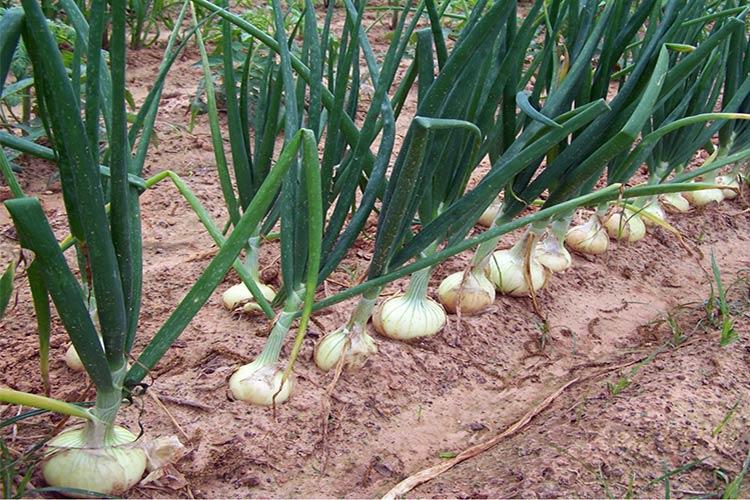
The choice of variety depends on the region. For example, for the southern region, three types are used: early, mid-season, and late. In the eastern and western regions, the best results come from early and mid-season varieties of onion sets. In the northern regions, an early variety is needed.
| Ripening period of varieties | Name of the variety | Onion color | Description |
| Early varieties, 90-100 days | Stuttgarter Riesen | Golden | Shape: flat-round. Flavor: pungent. Heads up to 180 g. |
| Sturon | Golden | Shape: oblong, round. Semi-sharp flavor. Grows up to 150 g. | |
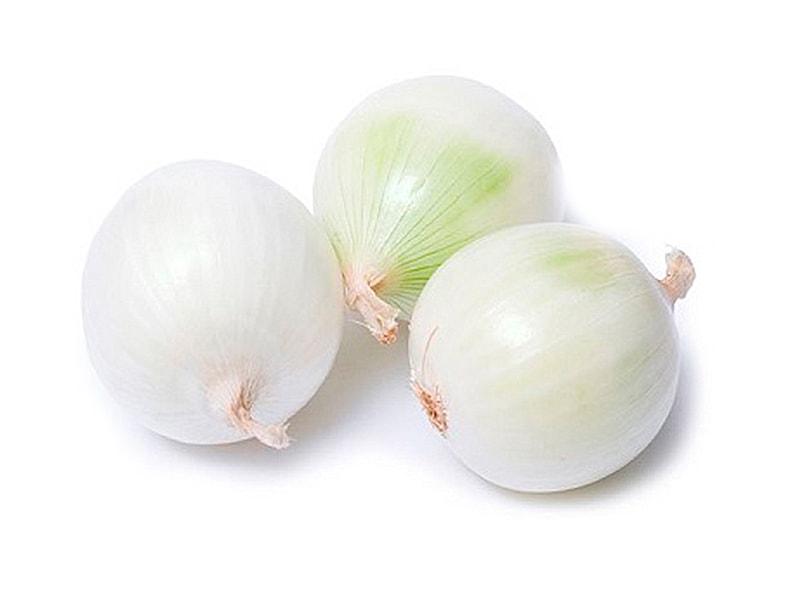
| Nevada | White | Shape: round. Taste: semi-sharp. Weight: up to 100 g. | |
| Sierra Blanca F1 | White | Shape: round. Taste: semi-sharp. Weight: up to 250 g. | |
| Red Baron | Red-violet | Shape: round, proportional. Mildly spicy flavor. Grows up to 150 g. | |
| Carmen | Red-violet | Shape: round-oblong. Mildly spicy flavor. Heads up to 120 g. | |
| Mid-season, 100-120 days | Centurion | Golden | The bulb is elongated and has a semi-sharp flavor. Weight: up to 150 g. |
| Rumba | Golden | The shape is round, the taste is spicy, the weight is up to 120 g. | |
| Comet F1 | White | The shape is round and proportional. The taste is sweet and spicy. Weight up to 70 g. | |
| White Jumbo | White | The shape is round and flattened. The taste is sweet and slightly spicy. Weight ranges from 120 g to 2 kg. | |
| Veselka | Red-violet | The shape is round and flattened. The taste is mildly spicy. Weight up to 70 g. | |
| The Black Prince | Red-violet | Round shape. Mildly spicy taste. Weight up to 100 g. | |
| Late varieties, 120-140 days | Cabo | Golden | The shape is oblong-round. The taste is mildly spicy. Weight up to 150 g. |
| Senshui | Golden | The shape is flat and round. The taste is semi-sharp. Weight up to 250 g. | |
| Bello Blanco F1 | White | The shape is round, proportional, and even. The taste is sharp. Weight up to 250 g. | |
| Silver Prince | White | Round shape. Mildly spicy taste. Weight up to 50 g. | |
| Yalta | Red-violet | The shape is flattened. The taste is mildly spicy without bitterness. Weight up to 250 g. |
To grow onions from seeds in 1 year, you should choose the following varieties:
- Shaman.
- Centaur.
- Red Baron.
- Exhibition.
- Oval.
- Alice.
- Sterling F1.
Depending on the region, onion seeds are sown in a container 60-70 days before planting outdoors. The soil should be light, loamy, and rich in organic matter. A layer of drainage is placed on the bottom of the container, followed by the soil mixture, and watered with warm water. Sow the seeds in rows spaced 1-1.5 cm apart, cover with glass, and place in a warm place. Ventilate the container daily, opening it for 20 minutes to an hour during the day. After 4-6 days, once the seedlings emerge, move the seedlings to a bright, cool place. Poorly growing seedlings should be fertilized with a fertilizer containing phosphorus, potassium, and nitrogen.
When to plant
Medium and large onion sets (over 1 cm) are resistant to short-term frosts down to -6°C, so they can be planted outdoors in the spring, from mid-April to the end of May. This is provided the soil is warmed to a depth of 10-15 cm and the temperature is at least 8°C.
Fall is a good time to plant small onion bulbs, as their small bulbs may not survive until spring. These bulbs will have a longer growing season, allowing them to develop into larger bulbs. Plant them 1.5-2 weeks before frost to prevent them from sprouting. It's best not to cover them, but there's a risk of freezing if there's no snow.
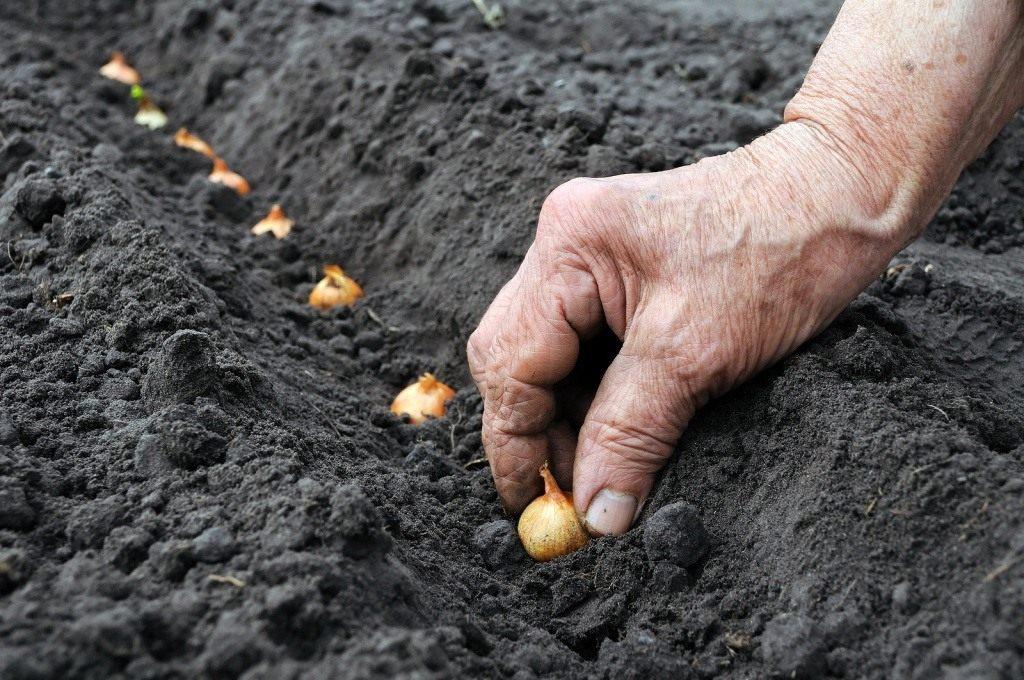
Before planting onions, the area should be treated with a fungicide and insecticide or sprayed with a manganese solution to disinfect the soil from diseases left over from previous plants.
Landing
Planting onion sets in spring to produce bulbs is carried out in several stages:
- Warming the bulbs for 7-10 days on a windowsill in the sun or near a heater or radiator.
- Then treat with a solution of manganese for 30-40 minutes.
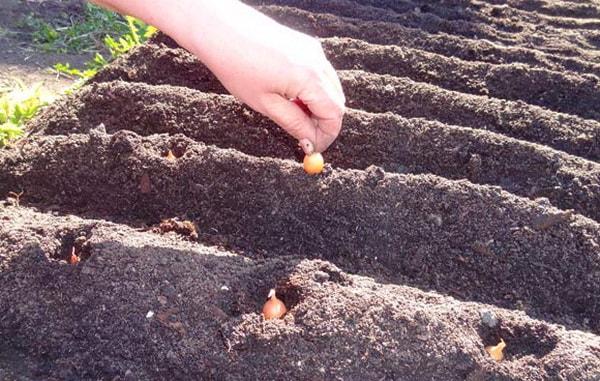
- Make shallow furrows in the prepared soil, 3-4 cm deep. Space the furrows 25-30 cm apart.
- If the soil is wet, do not water; if dry, water with warm water, possibly with a solution of potassium permanganate.
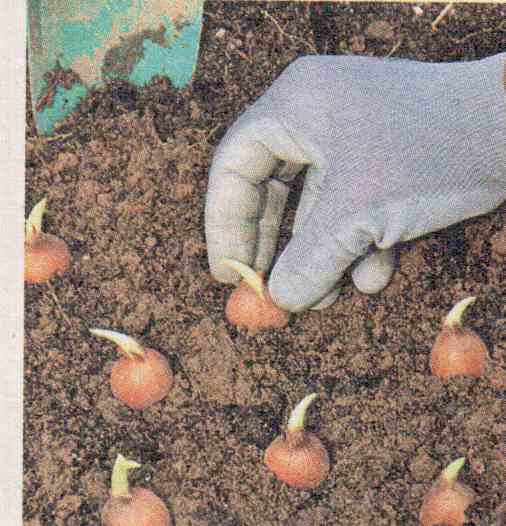
- Using a stick or your thumb, make holes in the ground at a distance of 10-15 cm and place the onion sets in them, tail up.
- Sprinkle with soil.
Take a look Also
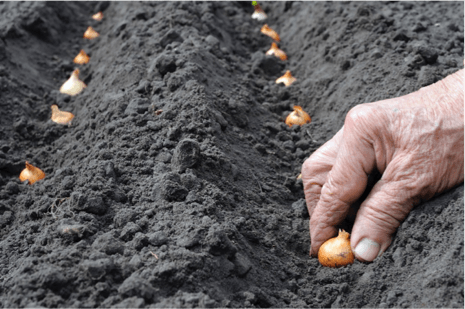 Planting the sets too deeply will result in small bulbs and delayed development. When determining the spacing between plants, consider the bulb size of the variety being planted.
Care
Onion care is carried out in several stages:
- Weed removal.
- Loosening the soil.
- Hilling is especially important when increasing green mass.
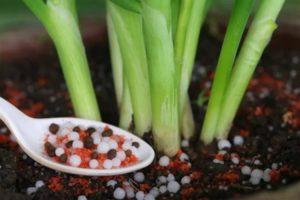
- Fertilizing onions Turnips are fertilized in 2-3 stages. First, if the soil is poor, it is fertilized with organic fertilizer before planting. Second, a nitrogen-potassium fertilizer is applied during the leaf growth stage. Third, a phosphorus-potassium fertilizer is applied during the bulb formation stage.
- Watering should be done as needed, but during the first half of onion growth, it should be done generously 1-2 times a week, and after the bulbs begin to form, once every 10 days.
- Prevention and treatment of diseases and pests. Prevention is carried out during preparing seed onions for plantingIt is very important not to tear off or break onion leaves to prevent diseases and pests from entering through the holes.
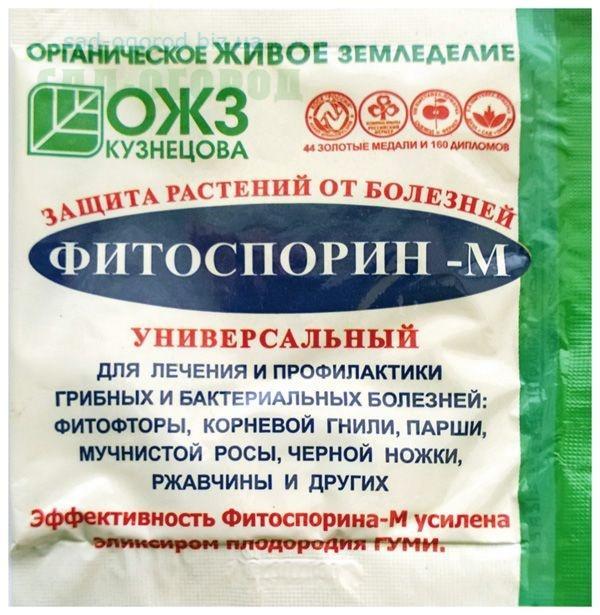
The most common diseases and pests affecting onions include onion flies, thrips, bacterial rot, downy mildew, and fusarium rot. When signs of disease appear, use broad-spectrum products such as Fitosporin and Alirin. Pest control includes Fitoverm, Aktara, Zeon, and Healthy Garden, as well as traditional remedies and mixtures.
Harvesting and storage
Harvesting begins in the first ten days of August and continues through the first ten days of September, depending on the variety and region. Turnips are harvested in the morning hours on a dry, sunny day. They are pulled from the ground by the tops and left in the garden bed to dry until sunset. In the fall, after harvesting, they are placed in a dry place and spread on paper to dry. The green tops can be cut off, and the dried tops can be tied in a knot. After 1-2 days, tie a bow into loose bunches and leave to dry for several days in a warm place.
Onions should be stored in a cloth bag, crate, or nylon tights. The temperature should not exceed 4°C (39°F) in a dark, cool, and ventilated place.
Related posts:
 50 types and varieties of perennial onions with descriptions, cultivation, and care
 How and when to plant onions to get large bulbs
 Description of the best varieties of onions, planting and care in open ground
 When to harvest leeks from the garden for storage, ripening times
 The beneficial properties of white onions, description of varieties, cultivation and care
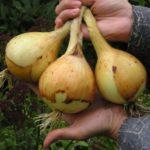 Description of the Exhibition onion variety, growing from seedlings, planting and care
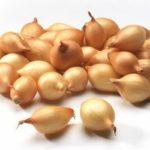 Planting, caring for, and growing onion sets in open ground, diseases, and how to save the crop
 Description of varieties and cultivars of wild onions, the subtleties of cultivation
It only seems like growing onions is a piece of cake. In reality, it requires careful care, maintaining the right temperature, and proper watering. This year, it made growing onions much easier for me. BioGrow (plant growth bioactivator) - the harvest was record-breaking in the fall!